
Most SEO tools have added “AI-powered” to their homepage copy. Almost none have meaningfully changed what they do.
The tools worth paying for in 2026 share one trait: they ground AI output in live search data. The tools not worth paying for use a language model to generate content that sounds SEO-savvy but isn’t built on anything real. That distinction — AI connected to search data versus AI running on vibes — is what this guide is actually about.
There’s also a second shift that most tool roundups miss entirely: SEO now means two things simultaneously. Traditional Google rankings still matter. But AI search visibility — monitoring your brand in Google AI Overviews, ChatGPT, and Perplexity — is now a separate metric, with click-through rates dropping 34–46% when AI summaries appear instead of blue links. The best stacks in 2026 handle both.
This guide covers how AI SEO tools actually work, how the top platforms compare by category, what a smart tool stack looks like at different budget levels, and the five mistakes that cost teams money before they see any ranking movement.
What AI SEO Tools Actually Do — And What They Can’t
Understanding the job each tool does prevents the most expensive mistake in this category: buying an all-in-one platform that does ten things adequately when you needed one thing done exceptionally.
The Four Jobs in an AI SEO Stack
Modern SEO tasks break into four distinct categories, each requiring different capabilities:
Keyword research and competitive intelligence maps search demand, identifies content gaps, and benchmarks competitors. Tools doing this job well need a real-time crawl index — a live database of what’s ranking, what’s getting backlinks, and what traffic volumes look like. You cannot do this with a language model alone. ChatGPT is excellent for processing SEO tasks like clustering keywords or writing schema markup, but it lacks a live keyword database — you cannot ask it for accurate search volume because it doesn’t crawl the web like a dedicated SEO tool.
Content optimization analyzes top-ranking pages for a target keyword and scores your draft against them. Tools doing this well use NLP models to identify the terms, structure, and coverage depth that correlate with ranking — not just keyword density, which stopped mattering years ago.
Technical SEO and site auditing crawls your site to surface indexing problems, Core Web Vitals issues, broken links, duplicate content, and schema gaps. This is the least “AI-glamorous” category and the most consistently impactful for sites with technical debt.
AI visibility tracking is the newest category. AI search traffic has surged 527% year-over-year, with ChatGPT now accounting for 20% of search-related traffic worldwide. Tools in this category monitor whether your brand and content appear in Google AI Overviews, ChatGPT responses, and Perplexity answers — and track competitors doing the same.
Why “All-in-One” Usually Means Compromise
Most professional SEO teams combine two to three tools rather than relying on one platform. The honest reason: no single platform leads in all four categories. Ahrefs has the deepest backlink index. Surfer has the best real-time content scoring. Semrush has the most complete AI visibility tracking. Frase has the best workflow for content briefs at lower cost. Paying for one platform to do all four means accepting second-best in at least three of them.
The 8 Best AI SEO Tools Compared — By Category
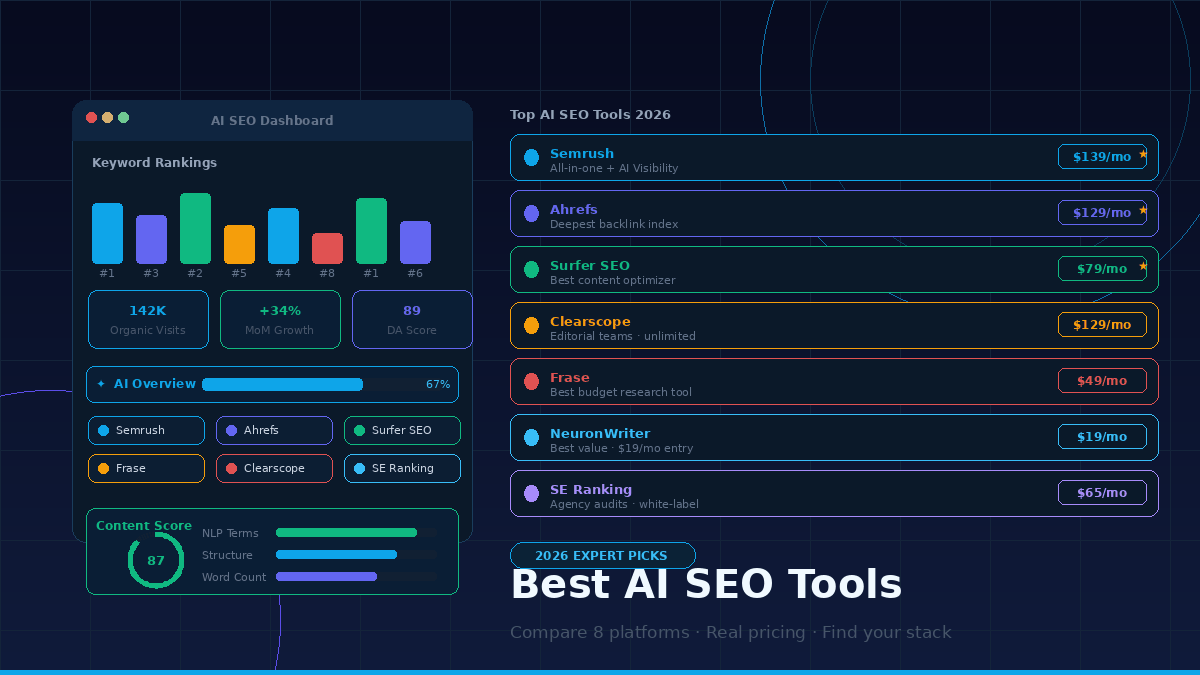
Best All-in-One Platform: Semrush
Semrush is the best all-in-one SEO platform — it covers keyword research, competitive analysis, site audits, backlink tracking, and content optimization in one tool. The 2025–2026 addition that changed the calculus for many teams is the AI Visibility Toolkit: a dedicated module that tracks brand mentions and citations across ChatGPT, Perplexity, and Google AI Overviews.
A marketing agency owner managing 15+ clients described it as: “Semrush One changed how we approach content strategy for clients. Being able to show them exactly where they’re mentioned in ChatGPT responses has been a huge selling point for our agency.”
The honest limitations: backlink data isn’t as comprehensive as Ahrefs for deep competitive analysis, and Semrush doesn’t provide real-time content optimization suggestions as you write — you’d need a separate tool like Surfer or Clearscope for that.
Best for: Agencies and marketing teams who want the broadest feature set in one platform and need AI search visibility tracking built in.
Pricing: Pro plan starts around $139.95/month; content marketing tools are available on Guru (~$249.95/month) and Business (~$499.95/month).
Best for Backlink Analysis: Ahrefs
Ahrefs has the deepest backlink index in the industry. If your strategy depends on link building or competitor gap analysis, the data quality is unmatched. The 2025–2026 Brand Radar feature brings AI visibility monitoring into Ahrefs’ orbit, built around search-backed prompts, large-scale AI answer monitoring, competitor benchmarking, cited-page discovery, and source analysis across channels that influence AI answers, including Reddit and YouTube.
In my testing, Ahrefs’ keyword difficulty scoring is the most reliable in the category for competitive niches — the scores hold up against actual SERP results better than Semrush’s equivalent metric. In 2026, Ahrefs is the choice for data purists who want the most reliable link index.
Best for: Link builders, SEO agencies focused on competitive gap analysis, and anyone for whom backlink data quality is non-negotiable.
Pricing: Lite from $129/month; Standard from $249/month; Advanced from $449/month.
Best for Content Optimization: Surfer SEO
Surfer leads on-page optimization. The Content Editor scores your draft in real time against the top-ranking pages for your target keyword — tracking NLP terms, heading structure, word count, and internal linking as you write. The AI Writer generates full drafts using Surfer’s optimization data, which means structure and term coverage are baked in from the first draft rather than retrofitted.
I found that Surfer-optimized articles consistently hit their target Content Score within one revision cycle, compared to two to three cycles when optimizing manually. The SERP Analyzer and Grow Flow features add a strategic layer — identifying which existing pages to refresh, not just which new pages to create.
The limitation is scope: Surfer is primarily a content optimization tool, not a full SEO suite. You’d still need a separate tool for keyword research, backlinks, and site audits.
Best for: Content writers, SEO content teams, and agencies that want every article optimized against real SERP data before publishing.
Pricing: Paid plans from $79/month.
Best for Editorial Teams: Clearscope
Clearscope takes a different philosophy from Surfer: less automation, more precision. The content reports are graded up to A++, with NLP-driven term recommendations calibrated specifically to what appears in top-ranking content. Writers stay in their native environment and get real-time Clearscope feedback in the sidebar — no context-switching, no copy-pasting between tabs.
In 2026, Clearscope added AI Tracked Topics, which shows how your brand is appearing in AI chatbot responses for your target keywords. That addition bridges the gap between traditional optimization and AI search visibility.
The structural limitation is real: Clearscope has no AI writing features, no content brief generation, no keyword research, and no content strategy layer — it’s purely an optimization tool. Most teams pair it with a separate research tool, which increases total stack cost.
Best for: Enterprise editorial teams with established workflows where content quality consistency across multiple writers is the primary goal.
Pricing: $129/month with unlimited seats — the unlimited-seats model makes it cost-competitive for teams with five or more content producers.
Best Budget Option for Content: Frase
Frase is the best-value option for solo creators and small teams focused on content briefs. The workflow centers on AI-assisted research, outline generation, and first drafts — tightly integrated so the research informs the draft structure automatically. In my testing, Frase’s SERP research module saved roughly 45 minutes per article compared to manual competitor research.
For pure content optimization on a budget, Frase delivers strong value at $115/month for unlimited articles. The per-seat add-on ($29/seat) makes team scaling manageable compared to Clearscope’s flat fee or Semrush’s per-user costs.
Best for: Solo SEO professionals, small agencies, and content teams where speed-to-brief matters more than optimization depth.
Pricing: Starter from ~$49/month; unlimited articles at ~$115/month.
Best Budget Content Optimizer: NeuronWriter
NeuronWriter is the best-value dedicated content optimization tool in the market right now — monthly plans start at $19 (Bronze tier). The core is an NLP-powered content editor that analyzes top-ranking pages and generates term suggestions, heading recommendations, and metadata guidance.
NeuronWriter excels in SEO accuracy for the price point — the Chrome extension lets you optimize directly in your CMS or Google Docs, eliminating the copy-paste friction that slows down tools requiring you to write inside their interface.
The trade-off is depth: NeuronWriter lacks the strategic content planning layer of MarketMuse or the AI writing integration of Surfer. It’s an optimization tool, not a research or strategy tool.
Best for: Budget-conscious solo marketers who need solid NLP optimization without enterprise overhead.
Pricing: From $19/month (Bronze) — the most accessible entry point in the category.
Best for Technical SEO: Screaming Frog + SE Ranking
Technical SEO has the clearest ROI of any SEO category — and it gets the least attention from AI tool roundups because it’s not glamorous. Screaming Frog remains the most thorough site crawler available. SE Ranking adds the AI-powered audit layer: automated issue prioritization, Core Web Vitals monitoring, and white-label reporting that agencies need.
I found SE Ranking’s audit prioritization particularly useful for client sites with 500+ pages — it surfaces the 10% of technical issues responsible for 80% of indexing friction rather than generating a 300-item report that no one acts on.
Best for: Agencies managing multi-client technical audits and teams with sites that have accumulated technical debt.
Pricing: SE Ranking from $65/month; Screaming Frog from $259/year.
Best for AI Visibility Tracking: Ahrefs Brand Radar / Semrush AI Toolkit
This category deserves its own entry because the tooling is genuinely new and the use case is different from traditional rank tracking. Ahrefs Brand Radar is the strongest specialist for AI visibility discovery, built around search-backed prompts, large-scale AI answer monitoring, competitor benchmarking, and source analysis across channels that influence AI answers.
Semrush One is the best overall pick for teams that want to connect traditional SEO and AI visibility in one workflow — handling keyword research, competitor analysis, rankings, AI Overviews, and brand citations without forcing teams to stitch together five separate dashboards.
If you’re already on Semrush, the AI Toolkit is included — use it. If you’re Ahrefs-native, Brand Radar is the better specialist. If you’re on neither, this is increasingly a tie-breaking factor in platform selection.
The Right Tool Stack at Every Budget Level
The honest answer to “which tool should I use?” is almost always a combination. Here’s how to stack intelligently rather than redundantly.
Solo Creator / Freelancer — Under $100/month
The highest-leverage stack at this budget: Google Search Console (free) + NeuronWriter ($19/month) + Frase ($49/month).
GSC handles rank tracking and indexing data. NeuronWriter handles per-article optimization. Frase handles research and brief generation. Total cost: $68/month. This stack covers 80% of what a $300/month all-in-one platform does for the content creation workflow — the gap is backlink analysis and deep competitive intelligence.
Small Team / Agency — $200–$500/month
The strongest stack: Semrush Guru ($249.95/month) + Surfer SEO ($99/month).
Semrush handles everything data-side: keyword research, backlinks, technical audits, rank tracking, and AI visibility monitoring. Surfer handles content optimization and the AI Writer. This eliminates the need for separate tools for brief creation, competitor research, and content scoring. Total: ~$349/month.
The alternative for link-building-heavy agencies: Ahrefs Standard ($249/month) + Frase ($115/month) = $364/month, with better backlink intelligence and lower content tool cost.
Mid-Market / In-House SEO Team — $500–$1,000/month
At this level, add Clearscope ($129/month) for editorial quality control across a content team with multiple writers — the unlimited-seats model pays off at five or more producers. Stack: Semrush + Surfer + Clearscope = ~$578/month before annual discounts.
Enterprise — $1,000+/month
Semrush Business at $499.95/month provides the most comprehensive marketing intelligence as a foundation. Add MarketMuse ($149/month) for strategic content planning and topic modeling across large content libraries, plus Screaming Frog ($259/year) for technical audits. The AI visibility layer comes built into Semrush Business at this tier.
5 Mistakes That Waste Your AI SEO Tool Budget
These patterns repeat across team sizes and industries. Each one burns budget before a single ranking moves.
Mistake 1: Buying a full suite when you have one bottleneck. Most SEO problems aren’t multi-channel — they’re concentrated. If 70% of your traffic loss came from a Core Web Vitals update, buying Semrush Guru to fix a technical problem is overkill. SE Ranking at $65/month solves the same problem. Identify your actual bottleneck before comparing feature lists.
Mistake 2: Using AI content tools without a live data connection. A language model writing SEO content without SERP data produces content that reads well and ranks poorly. The tool must analyze what’s actually ranking — not generate from its training data. Surfer, Clearscope, and Frase all ground their AI output in live SERP analysis. Generic AI writers do not.
Mistake 3: Ignoring AI search visibility entirely. Teams optimizing exclusively for traditional Google rankings are optimizing for a shrinking share of the search result page. CTRs drop 34–46% when AI summaries appear instead of blue links. Not tracking your AI Overview and ChatGPT citation status in 2026 is equivalent to not tracking rankings in 2018.
Mistake 4: Over-relying on AI-generated content without editorial review. AI-generated drafts need expert review to catch errors and maintain E-E-A-T standards. Google’s 2025 Helpful Content updates have made the signal clearer: content that demonstrates first-hand experience and expertise outranks content that merely covers the topic comprehensively. AI drafts well. It does not experience things. That gap is the writer’s job.
Mistake 5: Not measuring cost-per-article, only monthly subscription cost. Monthly subscription price is less useful than cost-per-article: at 50 articles per month, a $99/month tool costs roughly $2 per article, while a $19/month tool costs $0.38. Agencies producing volume content should model the math before defaulting to lower-priced tools — and before assuming higher-priced tools are overpriced.
Frequently Asked Questions
What are the best AI SEO tools for beginners?
For beginners, start with Google Search Console (free) and HubSpot’s free SEO tools, which offer on-page optimization guidance directly in the content editor. Frase ($49/month) is the best paid entry point — the research-to-brief workflow is intuitive and doesn’t require existing SEO knowledge to use correctly. Avoid starting with Semrush or Ahrefs until you’re ready to use more than 20% of the features.
Is Semrush or Ahrefs better in 2026?
They lead different categories. Ahrefs has the deeper, more accurate backlink index — essential for link building and competitive gap analysis. Semrush has the broader feature set, stronger AI visibility tracking, and better content marketing tools. Most agencies pick Semrush for breadth and Ahrefs for data precision. If forced to choose one, Semrush’s AI Visibility Toolkit gives it the 2026 edge for teams adapting to AI search.
Can AI tools replace an SEO strategist?
No — and the teams that try to replace strategic thinking with tool output consistently underperform. AI SEO tools automate research, content scoring, technical auditing, and tracking. Strategic judgment — which keywords align with business goals, which content clusters to build, how to structure a site’s information architecture — still requires a human. Tools raise the ceiling on execution; they don’t replace the person setting direction.
How accurate is AI-generated SEO content?
The content itself is usually grammatically correct and topically coherent. The SEO accuracy depends entirely on whether the tool uses live SERP data. Tools like Surfer SEO and Clearscope that score drafts against actual top-ranking pages produce content with strong structural and semantic alignment to ranking signals. Generic AI writers without SERP grounding produce content that requires significant revision to compete.
What is AI Overview optimization and do I need it?
AI Overview optimization (also called Generative Engine Optimization or GEO) is the practice of structuring content to appear in Google’s AI-generated answer summaries at the top of the SERP. It matters because those summaries appear before traditional blue links — which suppresses CTR on organic results below them. In 2026, any site targeting informational keywords should actively track AI Overview presence. Semrush’s AI Toolkit and Ahrefs Brand Radar both handle this.
How long does it take to see results from AI SEO tools?
Technical fixes from an audit tool (fixing crawl errors, improving Core Web Vitals, resolving indexing issues) can move rankings within 2–4 weeks. Content optimization results from tools like Surfer or Clearscope typically appear within 60–90 days, assuming the content is published and indexed promptly. Keyword research and content gap strategy takes 3–6 months to show measurable organic traffic impact. No tool collapses this timeline — they make the work faster, not the algorithm faster.
What’s the best free AI SEO tool?
Google Search Console remains the most actionable free SEO tool available — it shows exactly which queries drive impressions and clicks, which pages are indexed, and which have Core Web Vitals issues. Google Keyword Planner and AlsoAsked cover keyword research. These free tools collectively handle 40–50% of daily SEO tasks, according to practitioner surveys, before paid tooling adds meaningful leverage.
Conclusion
The best AI SEO tools in 2026 aren’t the ones with the longest feature lists — they’re the ones that solve your actual bottleneck with data grounded in live search results.
For keyword research and competitive intelligence, Ahrefs and Semrush lead. For content optimization, Surfer SEO and Clearscope dominate. For content briefs and research at lower cost, Frase is the strongest option. And for the fastest-growing requirement in the category — tracking brand presence in AI-generated answers — Semrush AI Toolkit and Ahrefs Brand Radar are the only tools doing it at scale.
Your action step: Before buying anything, run this audit. What is your primary SEO bottleneck right now — traffic, content quality, technical issues, or AI search visibility? Match your first tool purchase to that bottleneck specifically. Add the second tool only after the first one is running and producing measurable output.
The stacks that deliver ROI are almost always narrower than the ones that look impressive in a spreadsheet.
Let every read leave a mark—return to our home library and collect your next breakthrough.
