

You’ve used at least one of these tools. You’re wondering if you’re using the right one.
In 2026, ChatGPT, Claude, and Gemini are genuinely different products — not just different brands slapped on the same technology. I’ve run all three through hundreds of real tasks: long-form writing, code debugging, document analysis, research synthesis, and creative projects.
This guide cuts through the noise. You’ll get a clear breakdown of where each AI wins, where it fails, and exactly which one to use for your specific work. No vague comparisons. No affiliate bias. Just honest testing.
What Actually Separates These Three AI Models
Before comparing features, you need to understand the philosophy behind each one — because it explains almost every strength and weakness you’ll encounter.
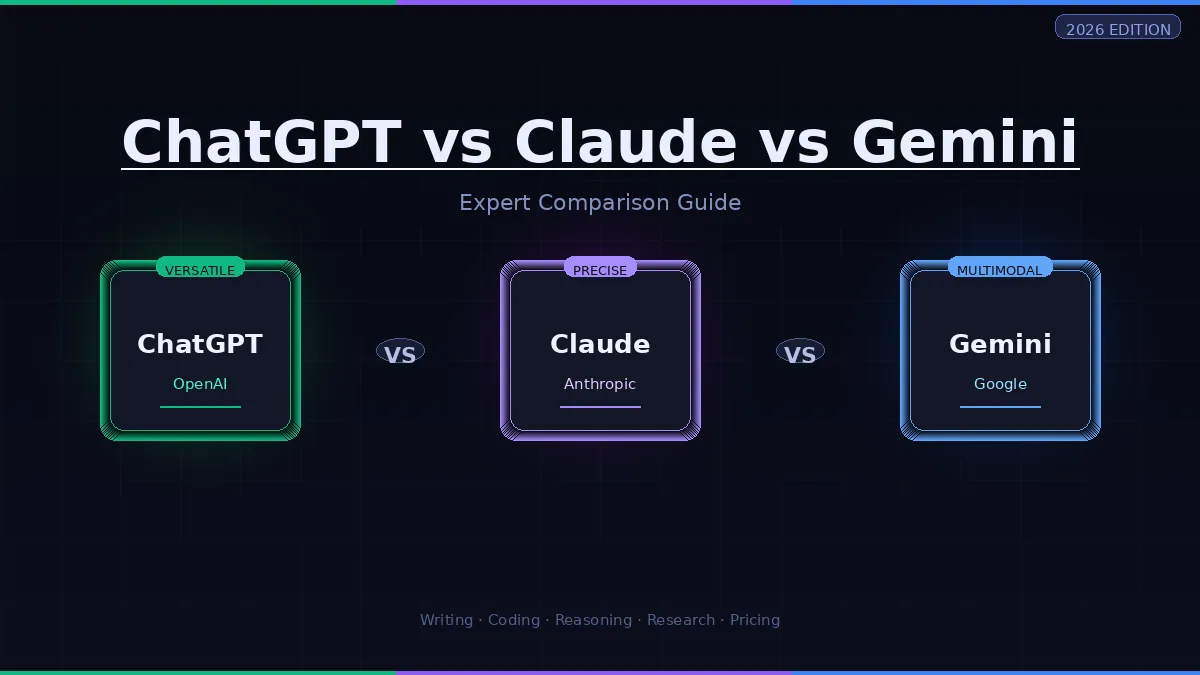
ChatGPT (OpenAI) is built for scale and versatility. OpenAI’s goal is a capable, friendly AI that integrates everywhere and works well for the widest possible range of tasks. ChatGPT is the Microsoft Office of AI not always the best at any single thing, but always available, always functional, and deeply embedded in workflows worldwide.
Claude (Anthropic) is built around precision and trust. Anthropic — founded by former OpenAI researchers designed Claude to produce fewer errors, handle longer documents reliably, and reason more carefully before answering. In my testing, Claude visibly slows down on complex problems in a way GPT rarely does. The answers are consistently better for it.
Gemini (Google) is built for the Google ecosystem and multimodal work. If your workflow runs through Google Workspace, Chrome, or Android, Gemini has native integrations nothing else can match. It also leads on raw context window size and image or video understanding.
That’s the cheat-sheet. Everything below is the proof.
Head-to-Head: Writing, Coding, Reasoning, and Research
Writing Quality
For long-form writing articles, reports, client deliverables, creative content Claude is the consistent winner in my testing.
The reason is apparent the moment you compare outputs side by side. Claude’s writing has coherent narrative flow, precise word choice, and a natural rhythm. It doesn’t open essays with “In today’s fast-paced world.” It doesn’t pad paragraphs to hit a length target. It writes the way a careful human writer would — then stops.
ChatGPT is a very close second. Its creative range is broader; it handles unusual tones, parody, and genre experimentation more flexibly. For short-form content and social media copy, the gap between ChatGPT and Claude is negligible.
Gemini trails on writing quality. Its output is technically correct but tends toward generic phrasing and flat structure. It’s adequate for internal documents. I wouldn’t use it for anything a client sees. For more on marketing-specific writing setups, see our roundup of the best AI writing tools for marketing.
Coding and Software Development
Claude leads on complex coding. This is one of the clearest performance gaps across the three models, and it shows up in real work rather than just benchmark scores.
In practice, the difference appears most in:
Debugging multi-file codebases — Claude holds more context and avoids contradicting itself mid-solution
Complex algorithmic problems — Claude reasons through edge cases instead of generating the first plausible-looking answer
Code review — Claude catches subtle logical errors that ChatGPT tends to surface-pass
ChatGPT holds its own across several key scenarios. Its Code Interpreter can run Python live and display results inline — genuinely useful for data analysis and quick experimentation. It also handles a wider range of niche frameworks and libraries than Claude. Ask it to build a component using an obscure library and it’s more likely to produce working output on the first attempt.
Gemini’s coding advantage is speed and context size. With a 1-million-token context window, you can paste an entire repository and ask questions about it — no chunking, no omissions. For Google ecosystem development (Firebase, Google Cloud, Android), it has native familiarity nothing else touches. The tradeoff is consistency: in my testing, Gemini sometimes gives noticeably different answers to the same coding question asked twice in the same session.
The practical verdict: Use Claude for production code and complex debugging. Use ChatGPT for versatile everyday coding and data tasks. Use Gemini for Google ecosystem work and very large codebase analysis.
Reasoning and Analysis
This is where Claude’s edge is most pronounced — and most valuable for serious work.
When I give Claude a complex strategic question — “What are the second-order consequences of shifting our pricing from seat-based to usage-based?” — it doesn’t list pros and cons. It builds a logical chain, identifies hidden assumptions, flags where its reasoning is uncertain, and delivers something genuinely useful.
ChatGPT produces well-structured responses that can feel authoritative even when the underlying logic is shallow. I’d call it “confident vagueness” — fluent and organized, but sometimes not actually engaging with the specific complexity of the question.
Gemini’s reasoning is improving but still inconsistent. On math and quantitative problems it performs well. On nuanced qualitative analysis, it tends to reach generic conclusions faster than it should.
For research, strategy work, and any task where the quality of the reasoning matters as much as the output, Claude is the clear choice.
Research and Information Retrieval
ChatGPT has the most mature web search integration. Its browsing is seamless, and its persistent memory feature — which carries preferences and context across sessions — makes it meaningfully better for ongoing research projects. Tell it once that you prefer primary sources over news aggregators and it remembers.
Gemini is the strongest for current information. Its Google Search backbone surfaces fresher data, integrates naturally with Google Scholar, and handles mixed-media research inputs (images, uploaded PDFs, audio) better than the others. In my testing, Gemini consistently provided more up-to-date answers on fast-moving topics.
Claude’s research strength is document analysis, not web search. Its 200,000-token context window means you can feed it an entire annual report or technical specification and ask pointed questions about it. It doesn’t lose track of section 2 by the time it discusses section 14 — a real problem with smaller-context models.
Pricing: What You’re Actually Getting at Each Tier
All three charge $20/month for their pro tier. The surface-level price is identical. The differences appear in what that $20 unlocks.
| Feature | Claude Pro | ChatGPT Plus | Gemini Advanced |
|---|---|---|---|
| Monthly Price | $20 | $20 | $20 |
| Free Tier | Yes (limited) | Yes (limited) | Yes (limited) |
| Context Window | 200K tokens | ~128K tokens | Up to 1M tokens |
| Memory | Basic | Strong (persistent) | Moderate |
| Web Search | Yes | Yes (strong) | Yes (Google-native) |
| Multimodal Input | Images, docs | Images, docs, audio | Images, video, audio |
| Integrations | Claude.ai, API | Plugins, GPTs, API | Google Workspace, API |
| Coding Tool | Claude Code (CLI) | Code Interpreter | Gemini for code |
| Business Plan | Custom | $25/user/month | Google Workspace add-on |
For API users building applications, pricing diverges significantly. Gemini Flash is the most cost-effective for high-volume tasks. Claude Sonnet sits in the mid-tier. GPT-4 Turbo is the most expensive per token. If you’re building a product on top of any of these models, API pricing should drive your decision more than the consumer tier. For teams using these APIs specifically to build chatbots and assistants, see our AI chatbot for business guide.
Where Each AI Actually Fails
Most comparison articles skip this section or bury it. Here’s what real daily use reveals.
ChatGPT’s Weaknesses
The biggest problem is calibration. ChatGPT produces confident, well-organized answers that feel authoritative even when the reasoning underneath is soft. It rarely flags its own uncertainty the way Claude does. For low-stakes tasks, this barely matters. For high-stakes decisions, it can quietly mislead you.
The plugin ecosystem, while large, is also uneven. Third-party GPTs vary wildly in quality and the overall experience is more fragmented than Claude’s cleaner interface.
Claude’s Weaknesses
Claude’s weaknesses are about ecosystem and reach, not quality. It doesn’t have ChatGPT’s plugin breadth, Google’s search integration, or Gemini’s native multimedia capabilities.
Its memory system still lags behind ChatGPT’s persistent cross-session memory — if you run many simultaneous projects, you’ll notice this.
Claude is also occasionally over-cautious. It sometimes adds unnecessary caveats or hedges on requests that are clearly reasonable. This has improved across model versions but it still happens at inconvenient moments.
Gemini’s Weaknesses
Gemini’s core problem is inconsistency. The same prompt can produce meaningfully different outputs on repeated attempts — in coding, analysis, and creative work alike. Any workflow requiring reproducibility will run into this.
The context window advantage is real but partially overstated. Quality and coherence degrade noticeably at very long prompts, even when the model technically accepts them. “Supports 1M tokens” and “performs well at 1M tokens” are two different things.
Writing quality, while functional, simply hasn’t caught up. For anything customer-facing, Gemini outputs consistently need more editing than Claude or ChatGPT equivalents.
Which AI Should You Actually Use?
Stop trying to pick one and use it for everything. The people getting the most from AI in 2026 use these tools strategically and in combination.
Here’s the decision framework I use in practice:
Use Claude when you need:
- High-quality long-form writing, reports, or analysis
- Complex coding and thorough code review
- Deep processing of large documents — legal, financial, technical
- Careful step-by-step reasoning on hard problems
- Research synthesis from uploaded files
Use ChatGPT when you need:
- Persistent memory across ongoing projects
- General-purpose brainstorming and versatile assistance
- Data analysis with live Python execution
- Integrations with third-party tools and platforms
- Creative writing with unusual formats or tones
Use Gemini when you need:
- Google Workspace tasks — Docs, Sheets, Gmail, Slides
- Multimodal tasks involving video, complex images, or mixed formats
- Current web information with Google Search depth
- Android or Google Cloud development
- Analyzing very large files or codebases in a single pass
If you’re only paying for one $20/month subscription and your work involves writing, research, or software development: start with Claude. If your workflow is deeply integrated with Google’s ecosystem or you need persistent memory across many simultaneous projects: start with ChatGPT or Gemini depending on which of those needs comes first.
Read More: Best AI Meeting Notes Tool: Expert Picks for 2026
Frequently Asked Questions
Is ChatGPT still the best AI in 2026?
ChatGPT remains the most widely used AI assistant — and for good reason. It’s the most versatile all-rounder on the market. But “most popular” no longer means “best at everything.” Claude outperforms it on writing quality, complex reasoning, and coding accuracy. The right choice depends entirely on what you’re actually using it for.
Which AI is best for coding in 2026?
Claude leads on complex coding tasks — particularly debugging, multi-file projects, and production-quality code generation. For data analysis workflows that need live code execution, ChatGPT’s Code Interpreter is hard to beat. Gemini is the strongest choice for Google ecosystem development and analyzing very large codebases in one prompt.
Is Gemini better than ChatGPT for everyday use?
For users deeply embedded in Google’s ecosystem — Gmail, Docs, Drive, Calendar — Gemini’s native integrations are genuinely superior. For general everyday use outside Google tools, ChatGPT’s persistent memory and broader plugin ecosystem give it the edge for most people.
Which AI has the largest context window?
Gemini 3.x Pro supports up to 1 million tokens — the largest of the three. Claude Pro offers 200,000 tokens by default, with larger configurations available. ChatGPT’s context sits around 128,000 tokens. Gemini technically wins on raw size, but Claude often handles long contexts more reliably in practice — quality at the extremes matters as much as the ceiling.
Are all three AIs really the same price?
At the consumer tier, yes — all three charge $20/month. The pricing diverges significantly at the API and enterprise level. Gemini Flash is the most cost-effective for high-volume API use. For enterprise deployments, Claude and ChatGPT both offer custom agreements, while Gemini typically bundles with Google Workspace pricing.
Which AI hallucinates the least?
Claude is the most calibrated on complex, multi-step reasoning tasks — it flags uncertainty rather than guessing with false confidence. ChatGPT has improved significantly but still produces more “confident-but-wrong” answers than Claude on nuanced problems. Gemini’s accuracy on factual tasks is generally solid but inconsistency across responses remains a concern.
Can I use all three AIs at the same time?
Yes — and many serious users do. A practical workflow: use Gemini for initial web research, Claude for deep analysis and writing, and ChatGPT for tasks that benefit from persistent memory or third-party integrations. All three have free tiers, so you can test all three before committing to any paid plan. For more options at zero cost, see our roundup of the best free ChatGPT alternatives.
Which AI is best for students?
For academic writing and research synthesis, Claude produces the most sophisticated output. For general homework help and broader platform integrations, ChatGPT’s ecosystem is hard to beat. Gemini is the most practical free-tier option for students already in the Google ecosystem through school accounts.
Conclusion
The honest answer to “which AI is best” in 2026 is simple: it depends, and the gap is narrower than the marketing suggests.
Claude wins on writing quality, complex reasoning, and coding accuracy. ChatGPT wins on breadth, ecosystem, and persistent memory. Gemini wins on Google integration, multimodal capability, and raw context size.
If you’ve been routing everything through one AI, you’re leaving real capability on the table. The practical move is to identify your two most common AI use cases, assign the right tool to each, and build a simple workflow around both.
Start with the tool that fits your primary need. Use it seriously for two weeks. Add a second tool once you know exactly what the first one doesn’t do well.
The AI that makes you 30% more productive isn’t the one with the best benchmarks — it’s the one you’ve learned to use with intention.
This story is complete, your hunger isn’t—step back onto our starting ground and chase the next spark.
