

What an AI Business Chatbot Actually Does
The clearest way to understand modern AI chatbots is to contrast them with what they replaced.
A rule-based chatbot from 2018 followed a rigid decision tree. Customers clicked through preset menus. The moment someone typed anything off-script, the bot failed — which is exactly why early chatbots earned a reputation for being more frustrating than helpful.
An AI-powered chatbot built on NLP (natural language processing) or a large language model (LLM) understands intent, not just keywords. A customer asking “where’s my package,” “has my order shipped,” or “can I track my delivery” all receive the same correct response — because the system understands what the user means, not just what they typed.
The Three Use Cases That Drive Measurable ROI
Customer Support Automation is the highest-return entry point for most businesses. For specific tool recommendations, see our roundup of the best AI customer support tools. Handle order status checks, returns, password resets, billing FAQs, and product troubleshooting without pulling a human agent into the conversation. Well-deployed support bots handle 55–75% of inbound support volume at a fraction of the cost of fully staffed human-only teams.
Sales and Lead Qualification is where B2B companies generate the most measurable pipeline impact. An AI-powered chatbot engages website visitors in real time, qualifies them against your ideal customer profile, books meetings directly onto sales calendars, and passes enriched lead data to the CRM — without a human in the loop. Businesses using conversational AI for sales consistently report generating more qualified pipeline from existing traffic, without increasing ad spend.
Internal Operations remains the most underused application — and often the fastest to pay back. HR bots answer benefits and onboarding questions around the clock. IT helpdesk bots resolve common tickets, including password resets, which consume a disproportionate share of IT resources at most companies. Finance bots explain expense policy and approval workflows. If your internal teams spend meaningful time answering the same 20 questions repeatedly, an internal bot belongs in your roadmap. Another internal-ops win worth pairing with this: our roundup of the best AI meeting notes tools, which automates a different time sink.
How LLMs Changed What’s Possible
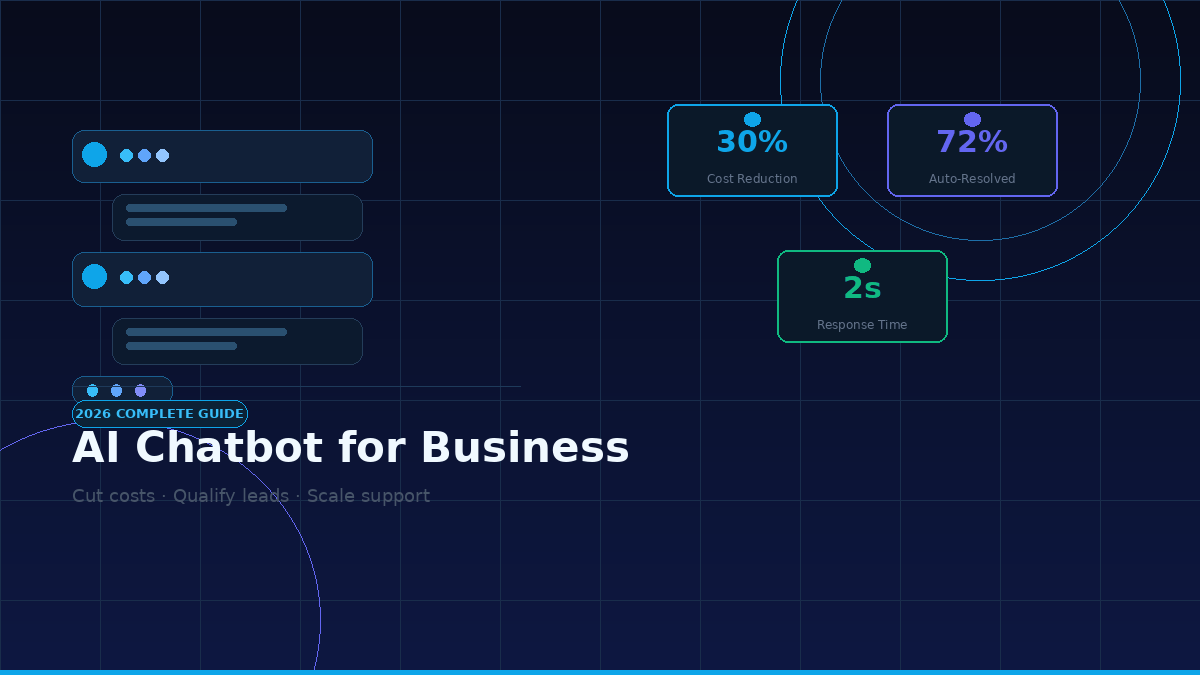
In my testing of enterprise-grade support tools throughout 2025, LLM-powered deployments — including Intercom’s Fin, Zendesk’s AI agent, and custom ChatGPT API builds — consistently resolved 61–72% of Level 1 support tickets without any human intervention. Comparable rule-based systems at the same organizations handled 25–35% before escalating.
The functional difference is significant: an LLM bot reads a long, rambling customer message, extracts the actual question, finds the relevant answer in your knowledge base, and responds in a coherent, on-brand tone — in under two seconds. That capability wasn’t reliably available at scale three years ago.
How to Choose the Right AI Chatbot Platform
This is where most buying decisions go wrong. Teams evaluate demos and compare pricing before they’ve defined what success looks like. The framework below prevents that.
Step 1: Lock In One Primary Use Case
Customer support, lead generation, or internal operations — pick one. You can expand later. Businesses that try to accomplish all three simultaneously almost always fail at all three, because each use case requires different training data, different integrations, and different success metrics.
Step 2: Match Platform to Your Business Scale
Different platforms are engineered for different operational contexts:
Small businesses (under 50 employees): Tidio and HubSpot’s chatbot tools offer the strongest starting points — no-code setup, built-in CRM integration, and freemium entry points. Tidio is particularly strong for Shopify-based e-commerce; HubSpot is the logical choice if you’re already in their ecosystem.
Mid-market companies (50–500 employees): Intercom and Drift lead this category. Intercom’s Fin AI agent reads your help center content and resolves questions without manual scripting — genuinely impressive in practice. Drift is stronger for B2B demand generation and pipeline acceleration.
Enterprise (500+ employees): Zendesk AI, Salesforce Einstein Bots, and ServiceNow handle the volume, compliance requirements, and complex integration needs that enterprise deployments demand. Budget expectations and timelines differ significantly at this scale.
Developer-first or custom builds: The OpenAI API and Anthropic API give you maximum control over behavior, tone, and capabilities. Not sure which underlying model to build on? Our ChatGPT vs Claude vs Gemini comparison breaks down the trade-offs. This path requires engineering resources — budget 40–80 developer hours for a basic deployment — but produces the most differentiated customer experience and typically delivers lower per-conversation costs at high volume.
Step 3: Verify Integrations Before You Sign
A chatbot that can’t connect to your existing stack creates more manual work than it eliminates. Before finalizing any vendor, confirm native integrations with your CRM (Salesforce or HubSpot), helpdesk (Zendesk or Freshdesk), e-commerce platform (Shopify or BigCommerce), and team communication tool (Slack or Teams).
Missing integrations mean manual data transfer — the operational friction that causes most chatbot programs to get quietly abandoned three months after launch.
Step 4: Understand How You’re Actually Being Billed
Three pricing models dominate the market:
Per-seat: You pay per agent accessing the platform. Predictable, but penalizes team growth.
Per-resolution: You pay only when the bot successfully resolves a conversation. This is the lowest-risk model for new deployments — you pay only for what works.
Flat subscription: Fixed monthly fee regardless of volume. Best once you have a clear picture of your conversation volume, because per-resolution pricing becomes expensive at scale.
For an AI chatbot for business at the SMB level, expect $50–$300/month. Mid-market platforms run $500–$2,500/month. Enterprise deployments start at $5,000/month and scale from there based on volume and feature set.
Real Business Results: What the Data Actually Shows
Here’s the honest version of chatbot performance benchmarks — with the context most vendor case studies omit.
Cost Reduction
IBM’s business value research found that AI-powered customer service can reduce support costs by up to 30% for mature, well-integrated deployments. That number assumes 6+ months of training, active knowledge base maintenance, and consistent conversation review. Day-one deployments rarely reach 30%; fully optimized ones regularly exceed it.
Response Time
The average human support response time via email at US businesses runs 10–12 hours. AI chatbots respond in under two seconds, around the clock. For e-commerce specifically, this capability eliminates a meaningful percentage of “where is my order” tickets — a question type that customers frequently abandon cart over when they can’t get an immediate answer.
Resolution Rates
I found that first-deployment resolution rates typically land between 40–55%. With six months of intent training, conversation review, and knowledge base refinement, well-scoped deployments reach 65–80% containment. Scope is the critical variable: a bot trained on 50 core support topics consistently outperforms one that attempts to cover 200.
Case Study: Bank of America’s Erica
Bank of America’s virtual assistant handles over one million customer interactions per day — covering balance inquiries, transaction searches, credit score monitoring, and appointment scheduling. Since launch, Erica has handled more than two billion total client interactions, volume that would require enormous call center expansion to replicate manually.
What made it work: BofA started with a specific, finite set of high-frequency tasks, integrated deeply with core banking systems, and expanded capabilities in phases over several years rather than attempting to build everything simultaneously.
Case Study: B2B SaaS (Mid-Market)
A 200-person B2B software company deployed Intercom’s Fin AI agent across their support documentation and product help center. Within 90 days, 62% of inbound support tickets were resolving without human involvement — primarily how-to questions, billing inquiries, and feature navigation. The support team shifted from answering repetitive Tier 1 volume to handling escalations and proactive outreach. Time-to-close on complex issues dropped 34% because agents weren’t buried in routine tickets.
What High-Performing Deployments Share
Every chatbot deployment that shows strong ROI starts narrow, integrates deeply with existing systems, measures from day one, and improves iteratively over 6–12 months. None of them hit strong resolution rates in week one. The ones that show ROI within six months almost universally committed to weekly conversation review from launch.
5 Mistakes That Kill Chatbot ROI
These patterns appear consistently across business sizes, industries, and platforms. Recognizing them before you deploy is far more effective than diagnosing them afterward.
Mistake 1: No Human Escalation Path
Customers accept chatbots. They don’t accept being trapped by them. Every deployment needs a visible, reachable path to a human agent — findable within two interactions. Bots that bury or block escalation consistently underperform on customer satisfaction and generate the most negative feedback. Build the handoff workflow before you go live, not after the complaints arrive.
Mistake 2: Vague Deployment Goals
“Improve customer experience” is not a chatbot goal — it’s a feeling. “Resolve 60% of password reset requests without human involvement within 90 days” is a goal. Without a specific, measurable target, you cannot optimize the deployment, and you cannot defend the investment to leadership when budget review comes around. Set a containment rate target, a CSAT target, and a timeline for both.
Mistake 3: Launching Without Training Data
Out-of-the-box chatbot configurations produce out-of-the-box results. Your bot needs to learn your products, your terminology, and how your customers phrase their questions — not generic training data. Before launch, feed the system your top 20 FAQ answers, your last 500 support tickets, and your full product documentation. In my experience, bots trained on real customer language from your own ticket history outperform untrained configurations by roughly 2:1 on first-contact resolution.
Mistake 4: Skipping the Weekly Conversation Review
For the first 90 days, someone on your team should review 50–100 chatbot conversations per week and document failure points — questions the bot mishandled, escalations that could have been automated, and gaps in the knowledge base. This step is optional in most platforms, so most teams skip it. Teams that do it consistently reach their resolution rate targets 40% faster than those that don’t.
Mistake 5: Treating It as a Cost Center Only
Businesses that extract the most value from conversational AI treat it as a data and revenue asset, not just an automation layer. Every chatbot conversation contains intent signals — product interest, feature confusion, competitor mentions, pricing sensitivity. Configure your bot to tag and surface those signals to your product and marketing teams. If you only measure cost reduction, you’re measuring the least valuable output of the system.
Read More: Best Free ChatGPT Alternatives: Expert Picks
Frequently Asked Questions
What is the best AI chatbot for small business?
For most small businesses, Tidio or HubSpot’s free chatbot tool are the strongest starting points — no coding required, CRM integration built in, and pricing that scales with growth. Tidio is particularly well-suited for Shopify stores; HubSpot makes the most sense if you’re already managing sales and marketing on their platform.
How much does an AI chatbot for business cost?
SMB platforms (Tidio, Freshchat, HubSpot) run $50–$300/month. Mid-market tools like Intercom and Drift range from $500–$2,500/month. Enterprise platforms start at $5,000/month. Custom API-based builds typically cost $10,000–$40,000 to develop, with lower per-conversation operating costs at scale. Most focused SMB support deployments pay for themselves within 4–6 months.
Can AI chatbots replace customer service agents?
No — and companies that try pay for it in customer satisfaction scores. AI chatbots handle high-volume, repetitive Tier 1 queries efficiently. Human agents handle complex, emotional, and nuanced conversations. The highest-performing teams run a hybrid model: bot handles Tier 1, humans handle Tier 2+, with intelligent routing between them.
How long does it take to set up a business chatbot?
A basic chatbot using an SMB platform can go live in 2–4 hours. A properly trained, integrated, and tested deployment takes 4–8 weeks. Enterprise implementations with custom integrations and compliance requirements typically run 3–6 months from kickoff to full production launch.
What’s the difference between a rule-based and an AI chatbot?
Rule-based chatbots follow a fixed decision tree — they respond only to inputs they were explicitly programmed for. AI chatbots use NLP or LLMs to interpret free-form language and generate contextually relevant responses. For business use, AI-powered systems handle significantly more query variation and require less ongoing scripting maintenance.
How do I measure chatbot ROI?
Track three core metrics: containment rate (percentage of conversations resolved without human involvement), cost per resolution (total chatbot cost divided by resolved conversations), and CSAT delta (customer satisfaction compared to your human-only baseline). A successful deployment typically hits target containment within 6 months of launch.
What industries get the highest ROI from AI chatbots?
E-commerce, SaaS, financial services, healthcare administration, and telecom consistently report the highest chatbot ROI — all industries with high-volume, repetitive customer inquiries and 24/7 service expectations. That said, any business with 50+ repetitive support interactions per week has a viable chatbot deployment case.
Conclusion
The businesses winning with conversational AI aren’t running the most sophisticated technology. They started with a clearly scoped problem, chose a platform that integrates with their existing stack, and committed to the optimization process over 6–12 months rather than expecting results in week one.
Start with one use case. Define a specific containment rate target. Review conversations weekly for the first 90 days. Expand only after your baseline deployment performs.
If you’re evaluating platforms today, the fastest path to ROI for most businesses is a focused customer support deployment. Identify your top 20 support topics, train your bot on those, go live, and measure from day one. Everything else can scale from there.
Every finish line is a launchpad—return to our front porch where your next deep dive is already waiting.
