

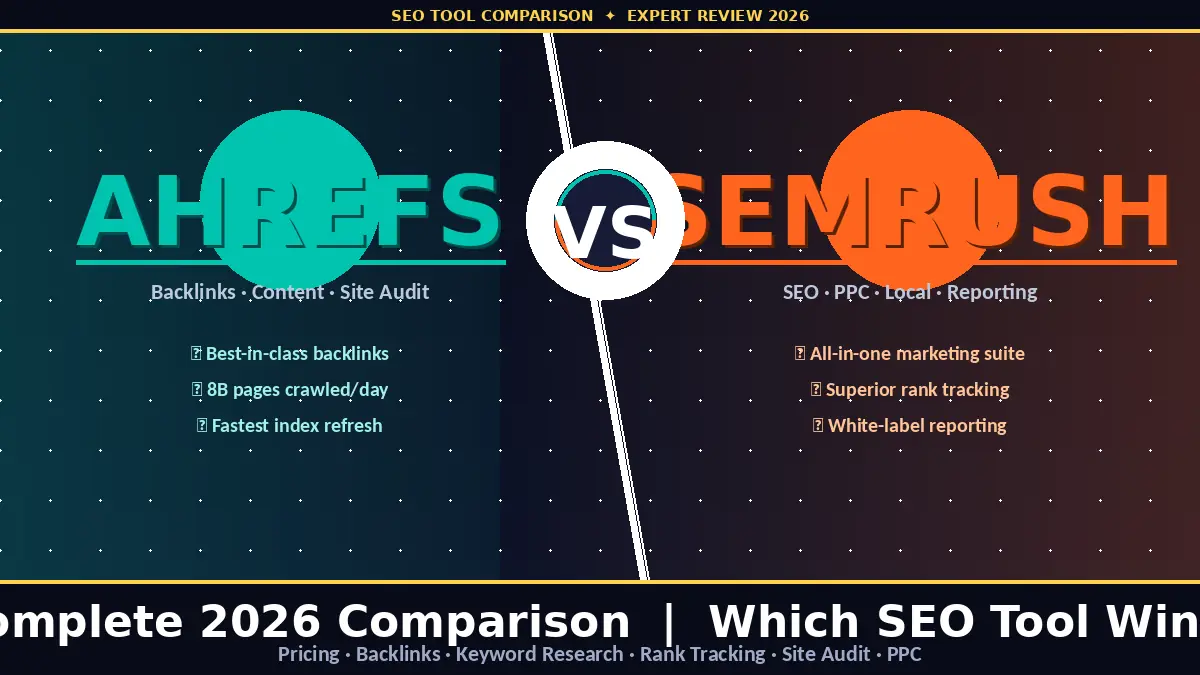
If you’ve spent more than five minutes researching SEO tools, you’ve hit this wall: Ahrefs or Semrush?
Both cost serious money. Both claim to be the best. And most comparisons you find online are either affiliate-driven, two years out of date, or written by someone who tested each tool for 20 minutes and called it a day.
I’ve spent the last three years using both platforms across client campaigns — from small business sites with under 10,000 pages to e-commerce domains driving over 400,000 monthly organic visits. The difference between them is real, specific, and depends entirely on how you work.
Here’s what this guide covers: a feature-by-feature breakdown, current 2026 pricing with the fine print that matters, and a clear recommendation for your situation — no hedging, no filler.
Key Differences: Ahrefs vs Semrush at a Glance
Before getting into features, understand what each tool is actually trying to be.
Ahrefs was built for SEOs. Its foundation is backlink analysis and content research, and everything else extends from that core. The interface is clean, fast, and opinionated — it steers you toward high-leverage organic search decisions without distraction.
Semrush was built to be a full marketing platform. It started with SEO and expanded deliberately into PPC research, content marketing, social media monitoring, local listing management, and competitor intelligence across paid and organic channels. That scope is both its biggest strength and its steepest learning curve.
| Feature | Ahrefs | Semrush |
|---|---|---|
| Backlink Analysis | ★★★★★ | ★★★★ |
| Keyword Research | ★★★★★ | ★★★★★ |
| Site Audit | ★★★★★ | ★★★★ |
| Rank Tracking | ★★★★ | ★★★★★ |
| PPC / Ad Intelligence | ★★ | ★★★★★ |
| Content Research | ★★★★★ | ★★★★ |
| Local SEO | ★★★ | ★★★★★ |
| Reporting & Dashboards | ★★★ | ★★★★★ |
| Ease of Use | ★★★★★ | ★★★★ |
The pattern holds throughout: Ahrefs wins on SEO depth, Semrush wins on marketing breadth.
Feature-by-Feature Breakdown
Backlink Analysis
Ahrefs built its reputation here, and the lead holds. Their crawler processes roughly 8 billion pages per day, with the link index refreshing every 15 to 30 minutes. In practice, you’re seeing new links — and lost links — faster than any competing platform offers.
When I ran parallel backlink analyses on the same domain across both tools, Ahrefs returned more accurate referring domain counts and flagged higher-quality link opportunities. Semrush showed higher raw backlink counts in some tests, but much of that was link spam and duplicate data inflating the numbers.
For link building work — prospecting new targets, monitoring outreach campaigns, and auditing toxic links — Ahrefs is the sharper tool.
Keyword Research
Both tools earn full marks here. Each database covers 20+ billion keywords globally, with search volume and difficulty data across 170+ countries.
The key distinction: Ahrefs includes a metric called Traffic Potential, which estimates the total organic traffic a page could earn by ranking for a keyword and all its close variants — not just the seed keyword. That’s a more actionable signal for content planning than search volume alone. Semrush answers with its Keyword Magic Tool: more filtering options, built-in question-format keywords, and faster cluster generation for teams building topical authority maps at scale.
I’d call it a draw — with a slight edge to Ahrefs for experienced SEOs and Semrush for larger teams or beginners.
Site Audit
Both tools crawl your site and output a prioritized technical health score. The execution differs enough to matter.
Ahrefs’ Site Audit is faster. On a 15,000-page site I audited last year, Ahrefs finished the full crawl in roughly 45 minutes. Semrush took close to 3 hours with comparable settings. Ahrefs also uses a cleaner three-tier issue system — errors, warnings, and notices — that makes triage faster without reading every flagged item.
Semrush flags a higher total volume of issues, which sounds like an advantage but often isn’t. A large portion tends to be low-priority items that require manual filtering before the data becomes useful. For time-constrained agencies, Ahrefs wins here on efficiency.
Rank Tracking
Semrush is the stronger choice. Its Position Tracking tool delivers daily updates across all plan tiers, tracks SERP feature visibility (featured snippets, local packs, image carousels), and lets you monitor rankings segmented by device and location simultaneously.
Ahrefs’ Rank Tracker works well but updates on slower schedules at lower plan tiers, and its SERP feature visibility tracking is less detailed. If your workflow involves regular client reporting on ranking movement, Semrush delivers cleaner outputs with less manual work.
Content Research
Ahrefs’ Content Explorer is one of the most underused features in SEO tooling. Enter any topic, filter results by backlinks, organic traffic, domain rating, and publication date, and you get a live picture of what’s actually performing in any niche.
I’ve used it to surface link-building targets that didn’t appear in traditional prospecting, identify content gaps competitors missed, and validate topic ideas before committing to production. It changes how you approach content strategy at a fundamental level.
Semrush offers a Content Marketing Toolkit including Topic Research, an SEO Writing Assistant, and Content Audit. The SEO Writing Assistant integrates directly into Google Docs and WordPress, which is genuinely useful for teams where writers and SEOs work in different tools. But for pure research depth, Ahrefs’ Content Explorer has no equivalent in Semrush’s stack.
PPC and Advertising Intelligence
Semrush wins this category, and it isn’t close. Its advertising research module surfaces competitor Google Ads copy, estimated monthly spend, keyword targets, and ad history going back years — intelligence that’s genuinely useful for both paid search managers and SEOs trying to understand why competitors are growing fast.
Ahrefs shows PPC keyword data but provides no meaningful competitor ad intelligence. If paid search is any part of your job, this gap alone may make the decision straightforward.
Pricing: What You Actually Pay in 2026
Both platforms raised prices over the last 18 months. Here’s the current breakdown, including the limits that actually affect day-to-day work.
Ahrefs Pricing
| Plan | Monthly | Billed Annually |
|---|---|---|
| Lite | $129/mo | ~$108/mo |
| Standard | $249/mo | ~$208/mo |
| Advanced | $449/mo | ~$374/mo |
| Enterprise | Custom | Custom |
Semrush Pricing
| Plan | Monthly | Billed Annually |
|---|---|---|
| Pro | $139.95/mo | ~$117/mo |
| Guru | $249.95/mo | ~$208/mo |
| Business | $499.95/mo | ~$417/mo |
At entry level, the tools are priced nearly the same — Ahrefs Lite at $129 vs. Semrush Pro at ~$140. But what you get at that tier matters more than the $10 difference.
Ahrefs Lite limits you to 6 months of historical data, restricted report row exports, and no API access. For most solo SEOs, these limits feel manageable at first — but they tend to trigger an upgrade within 3–6 months of active use.
Semrush Pro caps you at 5 projects, 500 tracked keywords, and 100,000 crawled pages per month. If you manage even 3–4 client accounts simultaneously, you’ll hit the project cap immediately and need Guru at $250/month to function.
At the mid-tier, both tools land at almost identical annual pricing — Ahrefs Standard and Semrush Guru each come to roughly $208/month billed annually.
One frequently missed cost factor: Ahrefs charges usage credits for certain bulk operations. Teams running large-scale keyword or backlink exports regularly may encounter overage costs beyond the base subscription. Semrush applies row limits on exports but involves fewer surprise credit deductions in standard workflows.
Free access: Semrush offers a limited free plan (10 searches per day) and a 7-day free trial on Pro and Guru plans. Ahrefs does not offer a paid-plan trial, but Ahrefs Webmaster Tools gives site owners free access to backlink data and site audit for their verified domains — genuinely useful at no cost.
Who Should Choose Ahrefs — and Who Should Choose Semrush
The most common mistake in this decision: choosing based on feature lists instead of actual workflows.
Choose Ahrefs if you:
- Focus on organic SEO and link building as your primary work
- Run a content-heavy site or manage an editorial team
- Want the fastest, most frequently refreshed backlink data available
- Prefer a clean, focused interface over a platform with 50+ tools
- Work solo or on a small SEO-focused team without PPC responsibilities
Choose Semrush if you:
- Work at a digital marketing agency handling SEO, PPC, and content simultaneously
- Need local SEO with listing management across Google, Yelp, and Apple Maps
- Manage multiple client projects and need white-label reporting
- Have writers who need real-time SEO guidance inside Google Docs or WordPress
- Run Google Ads campaigns and want organic and paid intelligence in one platform
The “use both” scenario
It’s real, and it’s common at serious agencies. Ahrefs handles backlink research, competitor content analysis, and technical audits. Semrush handles rank tracking, client reporting, and advertising intelligence. If budget allows and you manage multiple accounts, the combination delivers coverage neither tool achieves alone.
If you can only pick one: Ahrefs for pure SEO, Semrush for full-channel marketing.
Frequently Asked Questions
Is Ahrefs or Semrush better for beginners?
Semrush is more beginner-friendly. Its onboarding flow, Keyword Magic Tool tooltips, and guided project setup make it accessible without prior SEO experience. Ahrefs has a cleaner interface but expects you to already know what you’re looking for. Both offer extensive YouTube channels and documentation — but Semrush’s structured guidance reduces the initial learning curve more effectively.
Which tool has the better backlink checker?
Ahrefs. Its index refreshes every 15–30 minutes, and its spam filtering consistently surfaces higher-quality referring domain data than competing tools. In head-to-head comparisons across real domains, Ahrefs returns more accurate unique referring domain counts and catches link losses faster. For link prospecting, outreach monitoring, and disavow file preparation, Ahrefs is the industry standard.
Does Semrush offer a free trial?
Yes — Semrush offers a 7-day free trial on its Pro and Guru plans, giving you full platform access during that window. Ahrefs does not offer a free trial on paid plans. However, Ahrefs Webmaster Tools provides free access to backlink analysis and site audit for any domain you verify ownership of, which is a genuinely useful no-cost option.
How accurate is the organic traffic data in each tool?
Neither tool gives you real traffic figures — only Google Analytics and Search Console do. Both Ahrefs and Semrush estimate traffic by modeling keyword rankings against average CTR curves. These estimates can run 20–50% off for newer or smaller sites. Use both tools as directional signals for competitive research and content gap analysis, not as accurate representations of your own traffic.
Which tool is better for agencies managing multiple clients?
Semrush. Its white-label reporting templates, multi-client management dashboard, and automated scheduled reports make scaling across client accounts significantly easier. Ahrefs does not offer native white-label reporting. Agencies that need polished branded deliverables will find Semrush’s reporting infrastructure far more practical — though many link-building-focused agencies still use Ahrefs as their primary research tool.
Can I do keyword research with either free version?
Semrush’s free plan allows up to 10 keyword searches per day — enough for light research but limiting for real project work. Ahrefs Webmaster Tools doesn’t include keyword research (it’s limited to your own site’s data). For meaningful keyword research, both tools require a paid plan. Semrush’s free trial gives the most useful window for evaluating keyword research capabilities before committing.
Is there a significant difference in data quality at entry-level plans?
Yes. Ahrefs Lite limits you to 6 months of historical data, which cuts off useful trend analysis. Semrush Pro’s 5-project limit is the bigger constraint at entry level for anyone managing multiple sites. Both plans deliver quality data within their limits — the friction is in the caps, not the data itself. Most active professionals outgrow entry plans within 3–6 months.
Conclusion
There’s a clear answer here — it just depends on who you are.
Ahrefs is the better SEO tool. If backlink analysis, content research, and technical audits are the core of your daily work, Ahrefs outperforms on every task that matters for organic search. Its data is fresher, its interface is cleaner, and its backlink intelligence is the best in the market.
Semrush is the better marketing platform. If you’re running SEO alongside paid search, managing multiple client channels, or need white-label reporting that scales across accounts, Semrush’s breadth delivers real value that Ahrefs doesn’t attempt to match.
Both tools start around $130 per month. Neither is cheap, and both reward users who commit to learning them properly.
Your action step: Start with Semrush’s 7-day free trial — run a full keyword research and site audit workflow on a real project. Then activate Ahrefs Webmaster Tools on your own domain and live with both for a week. After that, the right choice for your work will be obvious.
Insight isn’t a one-time gift—head back to our home collection and unwrap something new daily.
