
Stock photo subscriptions cost hundreds of dollars a year. Hiring a graphic designer for one campaign can run $500–$2,000. And waiting three days for a single asset revision is simply not how modern marketing teams operate.
AI image generators have changed that math entirely.
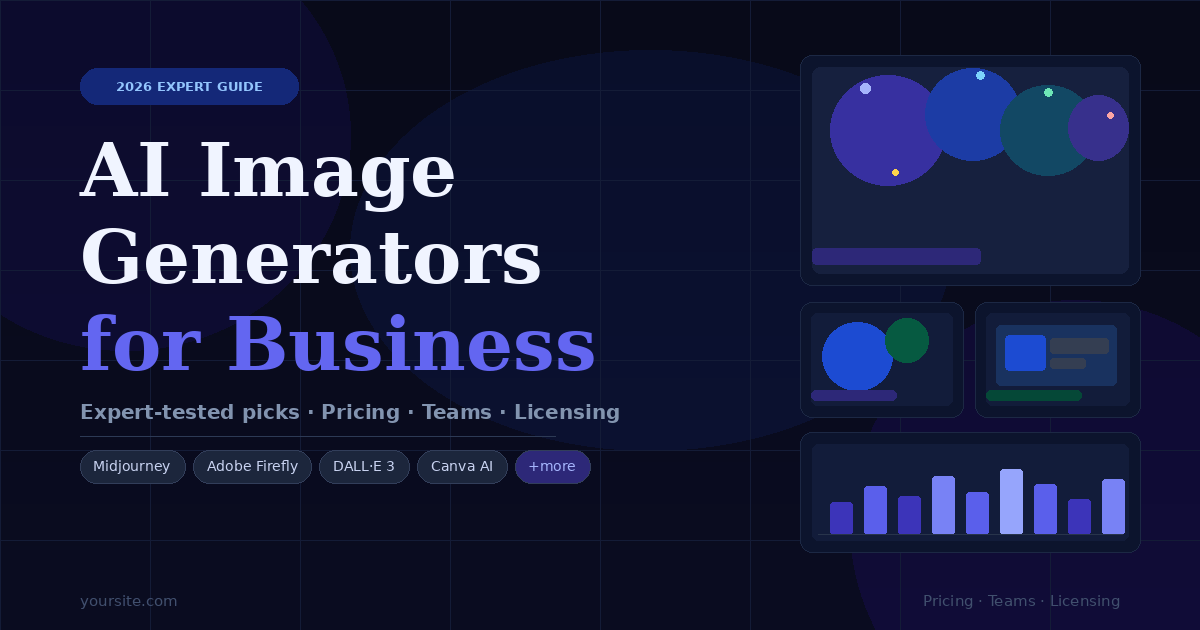
But not every tool is built with businesses in mind. Some excel at artistic output, others at speed, others at brand consistency — and the wrong pick wastes both money and time. In this guide, I’ve tested the leading platforms hands-on and ranked them by what actually matters to business users: output quality, brand control, licensing clarity, team features, and real-world cost.
What Makes an AI Image Generator Actually Business-Ready
Most comparisons focus on image quality. That’s the wrong place to start.
A solopreneur posting on Instagram has completely different needs than a 50-person marketing team managing a global brand. Before evaluating any tool, you need to ask four questions:
1. Who owns the output? Commercial licensing is non-negotiable. Some free-tier plans restrict commercial use entirely. Others grant full ownership only on paid plans. Read the terms — not the marketing page.
2. Can it stay on-brand? Generic images are useless if they don’t match your brand’s visual identity. Look for tools that support style references, custom training, or brand kit uploads. Without this, every output looks like it belongs to someone else’s company.
3. Does it scale with a team? Solo tools with single logins create bottlenecks. Business-grade platforms offer shared workspaces, user permissions, asset libraries, and usage dashboards. If your team of five all need access, you need seats — not workarounds.
4. What does it actually cost per asset? Monthly pricing hides the real number. Divide your plan cost by how many usable images you generate in a month. A $30/month plan that produces 10 usable images costs $3 per asset. A $100/month plan that produces 200 usable images costs $0.50. Do this math before committing.
With those filters in place, here’s how the top platforms stack up.
The Top AI Image Generators for Business in 2026
Midjourney — Best for Premium Creative Output
Midjourney remains the gold standard for image quality. If your brand lives in a visually premium space — luxury goods, architecture, fashion, editorial content — nothing else comes close to its aesthetic output. For a head-to-head against OpenAI’s tool, see our Midjourney vs DALL-E comparison.
In my testing across three dozen prompts, Midjourney v7 consistently produced images that looked like they came from a professional photo shoot or a high-end design agency. The level of lighting realism, texture depth, and compositional balance is genuinely impressive.
What businesses love:
- Photorealistic and artistic output at the highest quality tier
- Style references (–sref) let you feed it existing brand visuals and maintain consistency
- Strong community of prompt engineers sharing business-use workflows
Where it falls short:
- No native web app UI that non-designers find intuitive — it still runs through Discord, though a web interface has improved
- No built-in brand kit or team asset management
- Text rendering in images remains inconsistent (a known weakness across all AI image tools)
Pricing: Starts at $10/month for personal use; business teams typically land on the $96/month Pro plan for unlimited relaxed generations and commercial rights.
Best for: Creative directors, brand designers, agencies, premium consumer brands.
Adobe Firefly — Best for Teams Already in the Adobe Ecosystem
If your team runs on Creative Cloud, Adobe Firefly is the obvious integration play. It’s built directly into Photoshop, Illustrator, and Express, meaning your designers don’t need to leave the tools they already use.
What sets Firefly apart from a business risk standpoint is its training data policy. Adobe trained Firefly exclusively on licensed and public domain content, which significantly reduces the intellectual property exposure that concerns legal teams at larger organizations.
In practice, the image quality sits a tier below Midjourney for purely creative output — but for product backgrounds, marketing banners, social graphics, and template fills, it performs excellently.
What businesses love:
- Legally safer commercial use due to training data transparency
- Deep integration with Photoshop’s Generative Fill and Illustrator’s text effects
- Team plans with centralized billing and admin controls
- Vector output directly in Illustrator — a unique capability
Where it falls short:
- Standalone output quality doesn’t match Midjourney for high-end creative work
- Requires Adobe subscription for full functionality
- Generative credits run out faster than expected on active teams
Pricing: Included with Creative Cloud plans; standalone Firefly plans start at $9.99/month for 100 generative credits.
Best for: Marketing teams, in-house designers, enterprises with IP compliance requirements.
DALL·E 3 via ChatGPT — Best for Non-Designers and Fast Iteration
DALL·E 3, accessed through ChatGPT, has a distinct advantage over every other tool on this list: you can describe what you want in plain English and have a conversation about it. No prompt engineering required.
For business users who aren’t designers — content marketers, founders, sales teams, operations managers — this is transformative. You type “a clean product shot of a wooden desk with morning light coming from the left, minimal and modern,” and you get exactly that. Then you say “make the light warmer and remove the window reflection” and it adjusts.
In my testing, the conversational refinement loop is faster and more accessible than any other platform. It’s not the best image generator for pixel-perfect brand work, but for speed and usability across a non-technical team, nothing beats it.
What businesses love:
- Zero learning curve for non-designers
- Natural language refinement via chat interface
- Integrated directly into ChatGPT workflows — no context switching
- Solid text-in-image rendering, the best among current tools
Where it falls short:
- Less stylistic control than Midjourney or Stable Diffusion
- No team workspace or brand asset management
- Image style is identifiably “DALL·E” without heavy prompting
Pricing: Included in ChatGPT Plus ($20/month); API access available for developers building custom tools.
Best for: Content marketers, founders, small business owners, non-technical teams needing fast visual assets.
Canva AI (Magic Media) — Best for All-in-One Marketing Teams
Canva has quietly become a serious contender for business image generation, not because its AI model is the most powerful, but because it lives inside the workflow where most marketing teams already create content.
Magic Media generates images directly inside Canva, which means you go from generated asset to finished social post, presentation slide, or email banner in one platform. That workflow compression matters enormously when you’re shipping 40 assets a week.
The image quality is competent rather than exceptional. For branded social content, blog header images, and presentation visuals, it’s more than adequate. For a brand campaign requiring hero-level imagery, you’d reach for Midjourney.
What businesses love:
- Generates images inside the design tool, eliminating export/import friction
- Teams can collaborate on designs in real time
- Brand Kit integration maintains consistent colors, fonts, and logos
- No design skills required — accessible to everyone on the team
Where it falls short:
- Image quality lags behind dedicated AI image generators
- Limited fine-grained control over style, lighting, or composition
- Heavy reliance on Canva’s ecosystem; less useful if you use other design tools
Pricing: Included in Canva Pro ($15/month per user); Teams plan at $10/month per user (minimum 5 users).
Best for: Marketing teams, social media managers, content creators, small-to-mid-size businesses.
Stable Diffusion (via ComfyUI or RunDiffusion) — Best for Maximum Control and Custom Training
Stable Diffusion is the open-source engine underneath many commercial tools. Accessed directly through platforms like ComfyUI, Automatic1111, or managed cloud services like RunDiffusion, it offers a level of customization that no closed-source platform can match.
For businesses with specific, repeatable visual needs — product photography, character consistency for a brand mascot, highly specific style matching — Stable Diffusion with custom LoRA models (fine-tuned on your own images) is in a different category.
I’ve seen e-commerce brands train product-specific models that generate lifestyle shots consistent enough to replace $10,000-per-year photography budgets. That’s not a use case available on any SaaS platform.
What businesses love:
- Unlimited generations with no per-image cost once infrastructure is set up
- Custom model training on your brand’s specific visual style
- Full commercial rights with no platform restrictions
- Runs locally or on cloud — no data leaves your environment if privacy matters
Where it falls short:
- Steep technical learning curve — requires either technical staff or a managed service
- Setup time and infrastructure cost are real upfront investments
- Not practical for non-technical teams without significant onboarding
Pricing: Free (self-hosted); managed platforms like RunDiffusion start around $0.50/hour of GPU time.
Best for: Tech-forward companies, e-commerce brands with high visual volume, agencies building custom pipelines.
Jasper Art — Best for Content Marketing Teams Using Jasper
If your content team already uses Jasper for copywriting, Jasper Art is the natural image companion. It’s not the strongest standalone image generator, but inside Jasper’s content workflow, it eliminates tool switching entirely.
The image quality is powered by Stable Diffusion and DALL·E under the hood, so output is solid if not exceptional. The real value is workflow integration: write a blog post in Jasper, generate the header image in Jasper, publish from Jasper.
Pricing: Included in Jasper Pro plans starting at $49/month.
Best for: Content marketing teams already using Jasper for AI writing.
Common Mistakes Businesses Make With AI Image Generators
Skipping the Licensing Check
The biggest legal risk isn’t image quality — it’s using AI-generated images commercially without verifying your plan actually grants those rights. Free tiers on most platforms restrict commercial use. Before you put an AI-generated image on a product, ad, or client deliverable, confirm your subscription tier covers it.
Treating Every Tool as Interchangeable
Midjourney and DALL·E 3 are not the same product with different price tags. They solve different problems. Using DALL·E for a luxury brand campaign and using Midjourney for a quick social post are both the wrong tool for the job. Match the platform to the use case, not the other way around.
Ignoring Prompt Consistency
Generating one great image is easy. Generating 50 images that look like they belong to the same brand campaign is hard. Most teams don’t build prompt templates or style guides for their AI image workflow. The ones that do produce visually consistent content at scale. Create a prompt library the same way you’d create brand guidelines.
Underestimating Text in Images
Every major AI image tool still struggles with rendering legible, correctly spelled text inside images. If your design requires readable text — a banner, a poster, a product label — plan to add that text in your design tool after generation, not during. This saves dozens of re-generation attempts.
Not Testing Before Committing to an Annual Plan
Every major platform offers a free trial or a monthly plan. Run your actual production prompts on at least two platforms before committing to a year of billing. What works well for another company’s use case may not work for yours.
How to Choose the Right Tool for Your Business
Use this decision tree:
- Premium brand creative + highest quality output → Midjourney
- Adobe ecosystem + IP risk reduction → Adobe Firefly
- Non-technical team + fast iteration → DALL·E 3 via ChatGPT
- All-in-one design + social content → Canva AI
- High volume + custom brand training → Stable Diffusion
- Content marketing + Jasper already in use → Jasper Art
No single tool wins every category. Many business teams run two: one for high-quality hero creative (Midjourney), and one for everyday operational content (Canva AI or DALL·E 3).
Read More: Expert Picks: Best AI Background Remover Tools
Frequently Asked Questions
Can I use AI-generated images for commercial purposes? Yes, but only if your subscription plan explicitly grants commercial rights. Free tiers often exclude commercial use. Always verify in the platform’s terms of service before using generated images in paid advertising, client work, or product packaging. Most paid plans on major platforms include commercial licensing.
Which AI image generator produces the most realistic photos? Midjourney v7 and Stable Diffusion XL with photorealistic checkpoints currently lead for realistic image output. For business use, Adobe Firefly’s Generative Fill inside Photoshop is excellent for product images because it integrates with existing photography rather than generating from scratch.
How much does it cost to use AI image generators for business? Business-grade plans typically run $10–$100/month depending on the platform and usage volume. Midjourney’s Pro plan is $96/month. Adobe Firefly comes with Creative Cloud. DALL·E 3 is included in ChatGPT Plus at $20/month. High-volume teams using Stable Diffusion can reduce per-image costs significantly.
Do AI image generators own the images they create? No. On paid commercial plans, the user typically owns the output. The platform retains a license to use your prompts and outputs to improve their model in most cases. Read each platform’s IP terms carefully, as policies differ. Adobe Firefly is notable for offering indemnification against IP claims.
Can AI image generators match my brand’s visual style? With the right approach, yes. Midjourney’s style reference feature, Stable Diffusion’s LoRA training, and Adobe Firefly’s style presets all allow for brand-consistent output. The key is building a prompt template or style reference library that captures your brand’s specific visual language.
Are AI-generated images good enough to replace stock photography? For many use cases — blog headers, social posts, background images, concept illustrations — yes. For images requiring real people, specific locations, or legally verifiable authenticity (medical, legal, news), stock photography or original photography remains more appropriate. Most marketing teams use both.
What’s the best AI image generator for small businesses? DALL·E 3 via ChatGPT Plus ($20/month) offers the best value for small businesses with non-technical teams. Canva AI is ideal if you already use Canva for design work. Both have low learning curves, reasonable pricing, and solid output for everyday marketing content.
Is it legal to use AI-generated images in advertising? In the US, there are currently no laws prohibiting AI-generated images in advertising, provided you hold commercial rights through your platform subscription. Disclosure requirements vary by platform and context — some ad networks are beginning to require AI content labeling. Consult your legal team for regulated industries.
Conclusion
The right AI image generator doesn’t just cut costs — it changes how fast your team can execute.
The mistake most businesses make is picking one tool based on what looks impressive in a demo, rather than what solves their specific operational problem. Midjourney makes stunning creative. DALL·E 3 is fast and accessible. Adobe Firefly is the safe legal choice inside an existing Adobe workflow. Canva AI removes the tool-switching tax. Stable Diffusion handles volume and custom training at scale.
Start with your constraint, not the tool. What’s the bottleneck in your current visual content workflow — speed, cost, brand consistency, legal compliance, or team accessibility? That answer points directly to the right platform.
Pick one, run your real prompts for 30 days, measure the output quality and time saved, then decide. Most teams that do this never go back to stock photography for everyday content. If your content also includes video, our guide to the best AI video editing tools covers the same buying questions for that side of production.
Finished reading? Now go deeper—visit our home destination and fuel your curiosity again.
