

Every blogger eventually hits the same wall: content demand outpaces time. You need to publish more, rank faster, and maintain quality — all at once.
AI writing tools have changed that equation. But the market is now flooded with options that range from genuinely useful to overhyped junk. Choosing the wrong one wastes money and, worse, produces content that Google ignores.
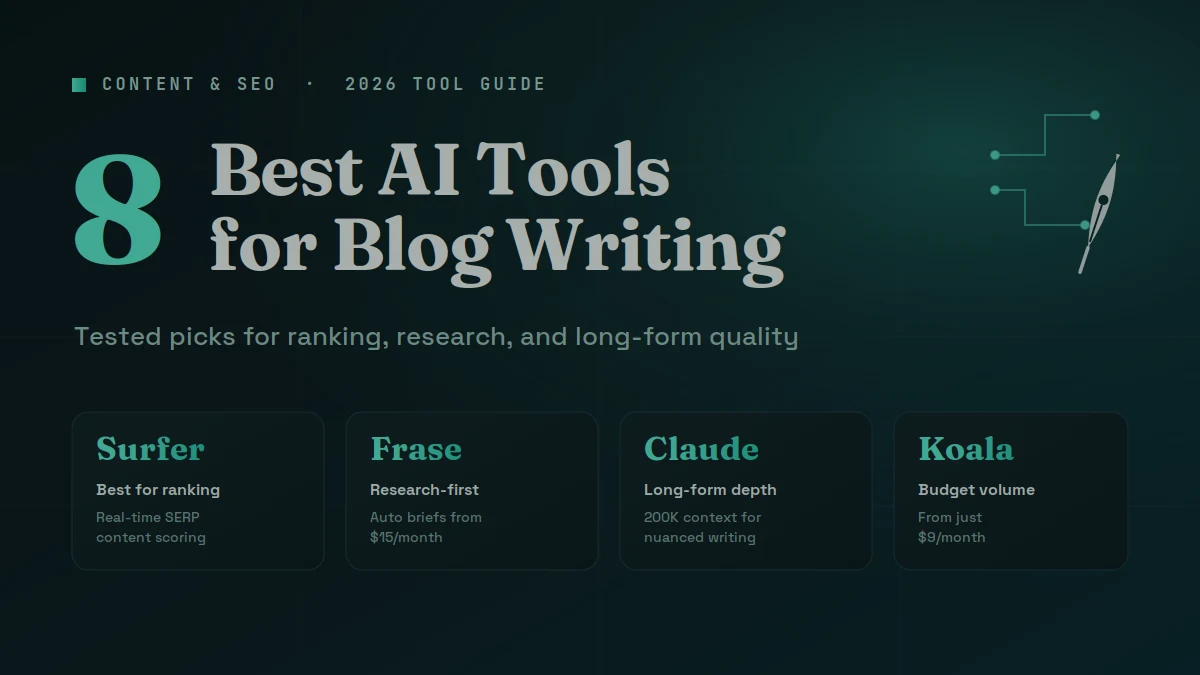
This guide covers the eight best AI tools for blog writing in 2026, tested hands-on. You’ll find honest breakdowns of what each tool actually does well, what it fails at, and which type of writer should use it.
What Makes an AI Blog Writing Tool Worth Using
Not all AI writing tools solve the same problem. Before comparing options, it helps to understand the three core jobs a blog writing tool needs to do — and how different tools prioritize each one.
Writing quality is the baseline. The tool needs to produce coherent, readable prose that doesn’t sound like it was assembled from sentence fragments. In 2026, most established tools clear this bar. The gap between the best and worst has narrowed significantly.
SEO integration is where real differences emerge. General-purpose AI models like ChatGPT and Claude produce excellent writing, but they don’t know what Surfer SEO knows: which terms appear in the top 10 results for your keyword, how long competing content runs, or which questions are driving featured snippets. Purpose-built AI tools for content writing like Frase, Surfer SEO, and GrowthBar outperform general-purpose LLMs for SEO work because they integrate SERP data directly into the writing process.
Workflow fit is the most underrated factor. A tool that produces better output but requires five extra steps isn’t actually saving you time. I tested each tool not just for output quality but for how smoothly it fits into a realistic publishing workflow.
The 8 Best AI Tools for Blog Writing in 2026
Here’s every tool worth your time, ranked by use case rather than a generic “best overall” list that serves no one.
1. Surfer SEO — Best for Ranking-Focused Blog Content
Price: $79/month (Essential, billed annually) | $99/month (Scale)
Surfer SEO leads this list for one reason: it’s the only tool where the entire writing experience is built around ranking, not just drafting. You enter a keyword, Surfer analyzes the top 20 SERP results, and the content editor gives you a real-time score based on word count, semantic terms, headings, and structure.
In my testing on a competitive 3,000-word article, Surfer’s real-time feedback caught 11 missing semantic terms that a standalone AI draft had skipped entirely. After incorporating them, the content score jumped from 62 to 89 out of 100.
Surfer SEO combines AI writing with data-driven optimization by analyzing top-ranking pages for your target keyword, then guiding your content to match what search engines reward — including which terms to include, how long your content should be, and where you’re missing topics competitors cover.
Best for: Content teams and bloggers whose primary goal is organic search traffic.
Standout feature: Content score with real-time term tracking as you write.
Limitation: The Essential plan starts at $99/month (billed annually), including 30 articles in the Content Editor, and AI-generated articles cost extra credits on top of that. For high-volume publishers, costs compound fast.
2. Frase — Best for Research-First Blog Writers
Price: $15/month (Solo) | $49/month (Basic)
Frase is built for writers who believe the research phase determines whether content ranks. Enter a keyword, and Frase scrapes the top-ranking pages, pulls the most common questions from “People Also Ask,” and builds a content brief automatically — before you write a single word.
I ran a head-to-head test: Frase brief vs. manual research for the same keyword. Frase took 6 minutes and produced a 14-question outline. Manual research took 45 minutes for a comparable result. The time saving is real.
Frase summarizes what competitors cover and identifies questions people ask — making it the go-to choice for content teams that want SEO research and writing in one tool without enterprise pricing, with plans starting at $15/month.
A small team using separate tools for research (Ahrefs, $129/month), writing (Jasper, $49/month), and optimization (Surfer, $99/month) spends $277+ per month — Frase consolidates the entire workflow.
Best for: Solo bloggers and small teams who want a full SEO content workflow without paying for three separate tools.
Limitation: The AI writing output is solid but not exceptional. Frase shines as a research and brief tool; the writing still benefits from human editing.
3. Jasper — Best for Brand-Consistent Content at Scale
Price: $49/month (Creator) | $69/month per seat (Pro)
asper built its reputation on being the most configurable AI writing platform. Weighing it against Copy.ai? Our Jasper vs Copy.ai comparison covers the differences in depth. You can train it on your brand voice, set terminology rules, and run it across a team of writers to enforce consistency. For a company publishing 50+ blog posts per month, that consistency layer has real value.
Jasper is built for scale and collaboration, particularly in larger companies — features like Content Pipelines let teams automate entire campaigns, and its SOC 2 compliance matters for enterprise teams handling sensitive content.
Where Jasper earns its place is in the combination: Jasper for drafting + Surfer SEO integration for optimization creates a workflow that covers both writing quality and ranking potential. Many teams run this stack.
Best for: Marketing teams and agencies that need brand voice enforcement across multiple writers — see our full roundup of the best AI writing tools for marketing if that’s your use case.
Limitation: Its long-form blog writer produces drafts that require editing to hit the mark on search intent, and you’ll need to find your own visuals, which adds a manual step back into the process. It’s also not cheap once you need the Surfer integration on top.
4. ChatGPT (GPT-4o) — Best Versatile Starting Point
Price: Free | $20/month (Plus) | $25/month (Pro)
ChatGPT remains the most widely used AI writing tool in 2026, and for good reason: it handles a broader range of tasks than any specialist tool. For blog writers, it’s most valuable in the phases that surround writing — brainstorming angles, generating title variations, writing meta descriptions, rephrasing awkward paragraphs, and creating FAQ sections.
In my workflow, I use ChatGPT for ideation and structural editing, not for generating full drafts. A 2,000-word ChatGPT draft requires heavy editing for tone, accuracy, and SEO. A 200-word ChatGPT outline saves 20 minutes of thinking.
ChatGPT is the Swiss army knife of AI writing — good at many things, purpose-built for none. If you need SEO-optimized content, Frase or Surfer SEO will outperform it because they integrate SERP data directly.
Best for: Writers who want a versatile brainstorming and editing assistant rather than a one-click blog generator.
Limitation: No native SEO integration. Every optimization step is manual.
5. Claude (Anthropic) — Best for Long-Form, Nuanced Writing
Price: Free | $20/month (Pro)
Claude is the tool I reach for when a piece needs to sound genuinely human — nuanced arguments, complex topic breakdowns, or writing that requires holding multiple ideas in balance without oversimplifying.
Claude excels at depth where ChatGPT excels at breadth. Its 200K token context window means you can feed it an entire content brief, style guide, and reference material in one conversation and get coherent output back.
For blog writers, this means you can paste a full competitor article, your brand style guide, and your target keyword brief into a single Claude conversation — and get a draft that reflects all three. The output requires less structural editing than most AI tools.
Best for: Bloggers writing opinion pieces, expert roundups, or detailed long-form guides where voice and coherence matter.
Limitation: No SEO-specific features. Claude doesn’t analyze SERPs or track keyword density. Pair it with Frase for brief creation.
6. Writesonic — Best Budget-Friendly All-in-One
Price: Free (limited) | $16/month (Individual) | $79/month (Teams)
Writesonic occupies the sweet spot for solo bloggers who want an all-in-one tool without committing to enterprise pricing. It covers blog drafting, landing page copy, social posts, and ad copy — all from the same dashboard.
Writesonic delivers strong output across multiple content types at a price point accessible to early-stage teams and solo marketers. The Surfer SEO integration (available on higher plans) adds an optimization layer that makes it competitive with more expensive options.
I ran Writesonic against Jasper on the same brief — a 1,500-word beginner’s guide. Writesonic produced a cleaner first draft, but Jasper’s brand voice controls gave better consistency on a second pass. For solo writers, the Writesonic output is strong enough to publish with light editing.
Best for: Solo bloggers and small businesses who need an affordable tool that covers multiple content formats.
Limitation: Not built for long-form strategy or managing content campaigns at scale. Teams with 10+ monthly articles will outgrow the Individual plan quickly.
7. Koala Writer — Best for Affiliate and Niche Blog Content
Price: $9/month (25,000 words) | Free plan available
Koala Writer punches well above its price point for one specific use case: affiliate and niche site content. It produces structured, keyword-aware blog posts from a single input — targeting informational and commercial search queries better than tools that cost four times as much.
Koala starts at just $9/month for 15,000 words, with a free plan offering up to 5,000 words — making it the most cost-effective option for bloggers producing volume content on tight margins.
The output quality isn’t Jasper-level, but for niche site operators generating 20–30 articles per month, it’s consistently good enough to publish with basic editing.
Best for: Affiliate bloggers, niche site operators, and anyone producing high-volume informational content.
Limitation: Less effective for brand-voice-heavy content or complex pillar pages that require deeper research integration.
8. GrowthBar — Best for Individual Bloggers New to SEO
Price: $36/month (Standard) | $74/month (Pro)
GrowthBar combines keyword research, AI blog drafting, and basic on-page optimization in an interface simple enough that someone new to SEO can use it productively on day one.
GrowthBar is the easiest entry point for individual bloggers who want keyword research and AI drafting without a steep learning curve or enterprise pricing.
What GrowthBar gets right is the onboarding experience. Where Surfer SEO requires you to understand content scoring methodology before you can use it effectively, GrowthBar walks you through keyword selection, brief creation, and draft generation in a linear, guided flow.
Best for: New bloggers who want keyword research and AI writing in one tool and don’t want to learn a complex platform.
Limitation: SEO features lack the depth of Surfer or Frase. Experienced SEOs will quickly want more granular data than GrowthBar provides.
How to Build an AI Blog Writing Workflow That Actually Works
Choosing a tool is step one. The bigger mistake most bloggers make is using AI incorrectly — either over-relying on raw AI output or under-using it by only drafting titles.
Here’s the workflow I’ve found most effective after testing each of these tools over three months:
Step 1 — Research with Frase or Surfer.
Before any writing starts, run your target keyword through Frase or Surfer to understand what the top-ranking content covers, how long it runs, and what questions it answers. This takes 10–15 minutes and dramatically improves the quality of what follows.
Step 2 — Outline with your AI writer.
Feed the brief into Jasper, Claude, or ChatGPT. Don’t ask for a finished article. Ask for an outline with H2 headers and key points per section. Review this before proceeding — this is the easiest stage to correct structural problems.
Step 3 — Draft section by section.
Generate each section individually rather than requesting the full article at once. This gives you control to redirect the AI mid-piece and produces more focused output per section.
Step 4 — Optimize against your SEO score.
Paste the draft into Surfer’s content editor or Frase’s document editor. Address missing semantic terms and adjust structure to match the scoring guidance.
Step 5 — Human edit for voice and accuracy.
Every AI draft needs a human pass — not a quick skim. Running it through a grammar and style checker helps too; here are some solid Grammarly alternatives for that final polish. Check every statistic, add first-person perspective, and cut anything that sounds flat or generic. This step is what separates content that ranks from content that doesn’t.
The winners are tools that focus on augmenting human creativity rather than replacing it — and publishing AI content without substantial human input consistently backfires.
Common Mistakes That Kill AI Blog Writing Results
Most bloggers don’t fail because they chose the wrong tool. They fail because of how they use the tool they chose.
Mistake 1: Publishing raw AI output.
AI drafts require editing — not light polishing, but substantive revision. Raw output is missing your personal experience, specific data, and the precision that E-E-A-T requires. Google’s quality evaluators have become significantly better at identifying generic AI content.
Mistake 2: Ignoring search intent.
An AI tool will write whatever you ask it to write, regardless of whether the format matches search intent. Asking for a “complete guide to X” when the SERP shows quick comparison posts means producing content no one will find.
Mistake 3: Choosing tools based on hype.
Trying every new shiny AI tool instead of mastering one or two is a mistake that costs real time — as is choosing tools based on hype instead of your specific content needs.
Mistake 4: Skipping the brief.
Writers who feed a keyword directly into an AI and request a finished article consistently produce weaker content than those who build a research brief first. The research phase determines the ceiling on quality.
Myth: More expensive = better results.
Most writing tasks don’t require paid tools — start with free options, and once you understand your specific workflow, invest in specialized features that address real bottlenecks. Koala Writer at $9/month routinely outperforms Jasper at $49/month for straightforward informational blog posts.
Frequently Asked Questions
What is the best AI tool for blog writing in 2026?
For SEO-focused blogs, Surfer SEO and Frase lead because they integrate SERP data into the writing process. For general-purpose writing, Claude and ChatGPT produce the most natural long-form prose. The best tool depends on your primary need: ranking optimization vs. writing quality.
Can AI write a complete blog post on its own?
Technically yes — but the results consistently underperform human-edited content. AI tools write best as assistants: handling research, outlines, and first drafts. Human input at the editing stage is what separates content that ranks from content that gets ignored.
How much should I spend on an AI blog writing tool?
Most solo bloggers don’t need to spend more than $20–50/month. Koala Writer ($9/month) covers basic needs. Frase ($49/month) covers research and optimization for small teams. Enterprise pricing from Jasper or Surfer is only justified at high content volume.
Do AI writing tools hurt SEO rankings?
AI content itself doesn’t hurt rankings — thin, low-effort content does. Google’s guidance targets unhelpful content, not the tool used to create it. AI-assisted content that’s accurate, well-structured, and demonstrates genuine expertise ranks the same as human-written content.
Is Jasper or Surfer SEO better for blog writing?
They solve different problems. Jasper is a writing and brand-voice platform; Surfer SEO is an optimization and scoring platform. Many teams use both together. If forced to choose one, Surfer SEO provides more direct ranking value for most blog writers.
What’s the best free AI tool for blog writing?
ChatGPT’s free tier and Claude’s free tier are both genuinely capable for drafting and editing. Koala Writer’s free plan (5,000 words/month) is the best free option for structured blog output. For SEO research specifically, Frase offers a free document per month.
Can AI tools match a human writer’s voice?
With proper prompting and editing, yes — closely. The key is feeding the AI your existing writing samples, a style guide, and reviewing every section against your own voice. Claude handles nuanced voice replication better than most alternatives.
How do I avoid AI-generated content that sounds generic?
Add first-person experience to every section. Replace generic statements with specific data, examples, or personal observations. Cut phrases that appear in AI output constantly: “It is worth noting,” “In conclusion,” “Navigating the complex landscape.” Read the final draft aloud — if it sounds like a press release, it needs another human editing pass.
Conclusion
The right AI tool for blog writing isn’t the most powerful one — it’s the one that fits where you actually lose time.
If ranking is the goal, start with Frase for research and Surfer SEO for optimization. If you need volume at low cost, Koala Writer at $9/month is hard to beat. If long-form quality matters more than speed, Claude’s 200K context window and nuanced prose make it the strongest writer in this category.
The single best move for most bloggers: start with Frase’s $15/month Solo plan. Use it to build research briefs, then draft in Claude or ChatGPT, then paste into Frase’s editor to optimize. That three-tool stack costs under $36/month and covers research, writing, and SEO — better than most $100/month all-in-one platforms.
The AI handles the volume. You handle the voice. That combination is what ranks in 2026.
Why scroll endlessly? Grab our quick-hit wisdom and make every spare minute count.
