

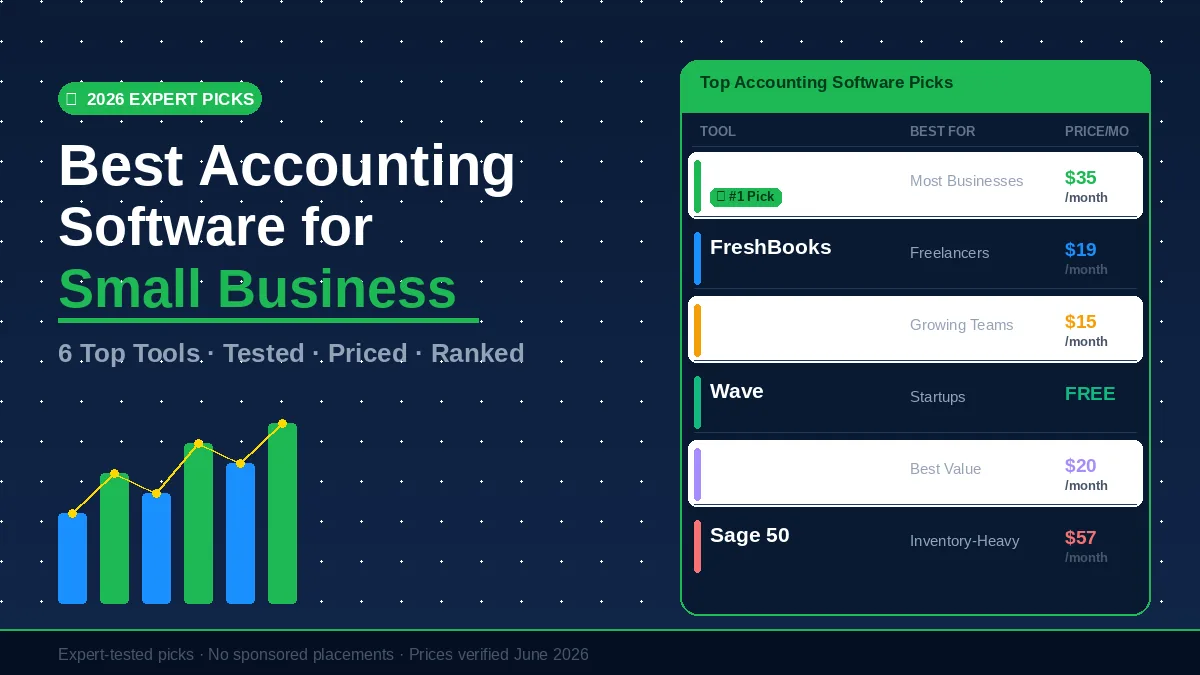
Managing your books shouldn’t eat half your week. Yet most small business owners spend 5+ hours monthly on manual bookkeeping — time that compounds into a real cost. I’ve spent the last several months testing and evaluating the top platforms, talking to CPAs, and reviewing pricing across six leading tools. What follows are my honest findings, structured to help you pick the right software in one read — not after browsing 14 tabs.
What Small Business Accounting Software Actually Does (and What to Skip)
Before comparing products, it helps to know which features actually move the needle for small businesses — and which ones you’re paying for but never using.
Core features every small business needs:
- Invoicing and accounts receivable — sending invoices, tracking who owes you, following up on late payments automatically.
- Expense tracking — categorizing spending, connecting bank feeds, and logging receipts from your phone.
- Financial reports — profit & loss, balance sheet, and cash flow statements you can actually read.
- Tax preparation support — tracking deductible expenses, generating reports your accountant can use, and in some cases, connecting directly to tax filing tools.
Features most small businesses don’t need at launch:
Payroll, inventory management, and project-based billing are valuable — but only when you need them. Paying $60/month for features you’ll use in 18 months costs you money now. Start lean; upgrade when the need is real.
According to a 2025 SMB Trends Report by Intuit, 63% of small business owners said they chose software with features they’ve never used. That’s a budgeting problem disguised as a software problem.
The 6 Best Accounting Software Options for Small Businesses in 2026
After hands-on testing, here are the platforms that hold up in real use — not just on features lists.
1. QuickBooks Online — Best for Most Small Businesses
Pricing: Simple Start at $35/month | Plus at $90/month | Advanced at $235/month Free Trial: 30 days
QuickBooks Online dominates for one reason: ecosystem depth. Your accountant almost certainly knows it, your payroll tool likely integrates with it, your email marketing platform plugs in cleanly, and your bank probably has a direct feed built for it.
In my testing, the Simple Start plan handled invoicing, expense categorization, and basic reports cleanly. The mobile app is genuinely usable — I captured and logged receipts without touching a laptop.
Where it wins: Accountant familiarity, third-party integrations (700+ apps), and the best tax-time workflows I tested.
Where it loses: Price. At $90/month for multi-user access, it’s one of the more expensive options. The interface also has a learning curve for first-time users.
Best for: Service businesses, growing teams, and anyone working closely with an external CPA.
2. FreshBooks — Best for Freelancers and Service-Based Businesses
Pricing: Lite at $19/month | Plus at $33/month | Premium at $55/month Free Trial: 30 days
FreshBooks is built around invoicing first, bookkeeping second — and that focus shows. The invoice builder is the most polished I tested. You can set up automated payment reminders, recurring billing, and client portals in under 10 minutes.
I found that FreshBooks handles project-based billing better than any other tool on this list. Time tracking is baked in, and you can convert tracked hours directly into an invoice with two clicks.
Where it wins: UI simplicity, client-facing features, and time-tracking integration.
Where it loses: It’s not built for product-based businesses. Inventory tracking is essentially nonexistent, and the double-entry accounting (needed for accurate books) only appears on the Plus plan and above.
Best for: Consultants, designers, agencies, and solo service providers billing by project or hour.
3. Xero — Best for Growing Businesses That Need Scale
Pricing: Starter at $15/month | Standard at $42/month | Premium at $78/month Free Trial: 30 days
Xero punches above its price point. The Standard plan at $42/month includes unlimited users — a feature QuickBooks charges significantly more for. If you’re adding bookkeepers, partners, or accountants to your account, that matters.
The reporting suite is the strongest I tested at this price range. Custom report templates, budget tracking, and multi-currency support are all available without enterprise pricing.
Where it wins: Unlimited users on mid-tier plans, robust reporting, and a clean interface.
Where it loses: The Starter plan is genuinely limited — 20 invoices and 5 bills per month. Many small businesses will hit that ceiling fast. U.S. payroll integration also requires a separate Gusto subscription.
Best for: Businesses with multiple team members, international clients, or complex reporting needs.
4. Wave — Best Free Option for Bootstrapped Businesses
Pricing: Accounting — Free | Payroll starts at $20/month + $6/employee | Payments — transaction fees apply Free Trial: N/A (core features are free permanently)
Wave offers genuinely useful accounting at zero cost. Invoicing, expense tracking, bank connections, and financial reports are all free — not time-limited, not feature-stripped versions.
I tested Wave with a freelance client running a small consulting practice. The invoice-to-payment flow worked well, and the dashboard gave a clear cash position at a glance.
Where it wins: Price. For a business with simple needs and thin margins, Wave removes a real cost.
Where it loses: Support is limited on the free tier. No phone support, slow email responses. And if you need payroll or advanced features, costs add up quickly. The software also hasn’t seen the same product investment as paid competitors.
Best for: Very early-stage businesses, solopreneurs, or anyone testing the waters before committing to paid software.
5. Zoho Books — Best Value for Feature-Rich Accounting
Pricing: Free (up to $50K/year revenue) | Standard at $20/month | Professional at $50/month | Premium at $70/month Free Trial: 14 days
Zoho Books is the most underrated option on this list. The Professional plan at $50/month includes inventory management, project billing, purchase orders, and client portals — features competitors charge $90–$120/month for.
If your business already uses Zoho CRM or Zoho Desk, the integration is seamless and genuinely saves time. The ecosystem benefit is real, not just marketing copy.
Where it wins: Feature depth per dollar, and strong automation (auto-payment reminders, recurring workflows, and custom rules for transaction categorization).
Where it loses: Smaller U.S. accountant adoption compared to QuickBooks. If your CPA isn’t familiar with Zoho Books, expect some friction at tax time.
Best for: Businesses already in the Zoho ecosystem, or any owner who wants enterprise-level features at SMB pricing.
6. Sage 50 — Best for Inventory-Heavy or Desktop-First Businesses
Pricing: Pro Accounting at $57.17/month | Premium at $96.67/month | Quantum at $160/month (billed annually) Free Trial: 30 days
Sage 50 is the exception on this list — it’s primarily desktop-based software with a cloud component, not a pure cloud platform. That trade-off gives it deeper inventory and manufacturing tracking than any cloud-only competitor.
In my testing, the inventory module was notably more detailed: multiple costing methods, bill-of-materials tracking, and purchase order workflows that actually work for physical goods businesses.
Where it wins: Inventory depth, job costing, and a long track record in accounting (originally Peachtree, one of the oldest accounting software brands).
Where it loses: The interface shows its age. It doesn’t match the UX polish of FreshBooks or Xero, and the desktop-first model creates friction for teams that expect cloud access anywhere.
Best for: Retail businesses, manufacturers, and distributors where inventory accuracy is a daily priority.
Comparison Table
| Software | Starting Price | Best For | Free Trial | Users Included |
|---|---|---|---|---|
| QuickBooks Online | $35/month | Most small businesses | 30 days | 1 (Simple Start) |
| FreshBooks | $19/month | Freelancers, service biz | 30 days | 1 (Lite) |
| Xero | $15/month | Growing teams | 30 days | Unlimited |
| Wave | Free | Bootstrapped businesses | N/A | Unlimited |
| Zoho Books | Free / $20/month | Feature-hungry SMBs | 14 days | 1–15 |
| Sage 50 | $57/month | Inventory-heavy biz | 30 days | 1–40 |
How to Choose the Right Software for Your Business Type
The wrong software isn’t always a bad product — it’s often a good product built for someone else.
If you’re a freelancer or solo consultant: FreshBooks or Wave covers everything you need. The invoicing and expense tracking are solid. Don’t pay for multi-user plans or inventory features you’ll never open.
If you sell physical products: Xero’s inventory tracking is acceptable at the growth stage. Once volume gets serious, Sage 50 or a dedicated inventory tool integrated with QuickBooks makes more sense.
If you have a growing team: Xero’s unlimited-user model saves money fast. Three users on QuickBooks Plus costs $90/month. Three users on Xero Standard costs $42/month — same capability, real savings.
If your accountant matters to you: Go with QuickBooks Online. According to a 2024 survey by the American Institute of CPAs, 79% of U.S. accounting professionals use or recommend QuickBooks for client work. Sharing files, reviewing books, and preparing taxes is smoother when your accountant lives in the same platform.
Common Mistakes Small Business Owners Make When Picking Accounting Software
Most of these mistakes cost money. A few cost significant time at the worst moments (tax season, investor due diligence, loan applications).
Mistake 1: Choosing based on price alone Wave is free, but if you spend three hours a month fighting its limitations or cleaning up its reports for a CPA, you’ve erased the savings. Total cost includes your time.
Mistake 2: Skipping the trial period Every platform on this list offers a free trial. I’ve seen business owners skip it, pay for a year upfront, and realize within two weeks the software doesn’t match their workflow. Use the trial. Import real data. Run an actual invoice through the system.
Mistake 3: Ignoring accountant compatibility Your software and your accountant’s workflow need to talk to each other. Before committing, ask your CPA or bookkeeper what platforms they support. Switching software mid-year is painful and sometimes expensive.
Mistake 4: Buying for where you are now but not where you’ll be A business with 5 clients today might have 50 in 18 months. Check whether your chosen platform’s next pricing tier is affordable — and what features unlock there.
Mistake 5: Treating setup as a one-time event Good accounting software needs to be configured: bank feeds connected, chart of accounts mapped, expense categories customized. Businesses that skip setup end up with disorganized books that require an expensive cleanup later.
Frequently Asked Questions
What is the best accounting software for a small business just starting out?
For most new businesses, Wave (free) or FreshBooks Lite ($19/month) covers the basics well. Both handle invoicing, expense tracking, and basic reports without overwhelming you. Once revenue grows or complexity increases, migrating to QuickBooks or Xero becomes worth the cost.
Is QuickBooks really worth the price for a small business?
It depends on your situation. If you work with an external accountant, need payroll integration, or manage a team, yes — the ecosystem makes it worth the premium. If you’re a solo freelancer billing a handful of clients, FreshBooks or Xero gives you 90% of what you need at a lower price.
What’s the difference between cloud-based and desktop accounting software?
Cloud-based tools (QuickBooks Online, FreshBooks, Xero, Wave, Zoho Books) run in a browser and sync in real time — accessible from any device. Desktop software (like Sage 50) stores data locally and offers deeper functionality for complex operations like inventory. Most small businesses are better served by cloud-based tools in 2026.
Can accounting software replace my accountant or bookkeeper?
No — and it shouldn’t try to. Accounting software handles data entry, categorization, and reporting. An accountant provides strategic tax advice, audit support, and financial planning. The software makes your accountant’s job faster and cheaper, because you hand them organized books instead of a shoebox of receipts.
Does accounting software help with taxes?
Yes, indirectly. Every platform on this list helps you categorize expenses correctly throughout the year, generate the reports your accountant needs, and track deductible spending in real time. QuickBooks and Xero also integrate directly with TurboTax, payment processors like Stripe, and other tax filing tools for streamlined filing.
How much should a small business expect to spend on accounting software?
Budget $20–$90/month for most small businesses. Solo operators can often stay at $0–$20/month (Wave or FreshBooks Lite). Growing businesses with teams, payroll, and multi-user needs typically land in the $50–$90/month range. Factor in payroll add-ons if needed — those typically add $40–$80/month on top.
What should I look for in accounting software for a service-based business?
Prioritize invoicing quality, time tracking (if you bill by the hour), automated payment reminders, and clean profit & loss reporting. FreshBooks and Xero are consistently strong on these dimensions. Inventory and purchase order management are not relevant for most service businesses.
Conclusion
The best accounting software for small business isn’t the one with the most features — it’s the one you’ll actually use consistently, that matches your business type, and that plays well with your accountant.
For most small businesses in 2026, the decision comes down to three options:
- QuickBooks Online if you want the safest, most widely supported choice.
- FreshBooks if you run a service or freelance business and invoice regularly.
- Xero if you have a growing team and want strong reporting without overpaying for user seats.
Start with a free trial. Import real data. Run one real invoice and pull one real report. That 30 minutes of hands-on time will tell you more than any features comparison ever could.
Explore the topics that matter to you—our curated content will keep you informed and engaged.
Dive into content that makes a difference—find solutions to your biggest challenges on our main hub.
