
Most professionals sit through 31 hours of meetings every month — and forget half of what was said within 24 hours. That’s not a memory problem. It’s a tooling problem.
An AI meeting notes tool fixes it: automated transcription, structured summaries, and action items without touching a keyboard. But transcription accuracy is now table stakes across every major platform. The real question is what happens after the transcript — and whether a bot showing up in your participant list costs you the candor you need.
This guide covers how these tools actually work, how the top seven compare on accuracy, pricing, and workflow fit, and the mistakes that quietly kill adoption before you see any ROI.
How AI Meeting Note-Takers Actually Work in 2026
Understanding the architecture matters, because it determines both privacy and performance.
Two Architectures — One Critical Difference
Every tool on this list uses one of two approaches:
Bot-based tools (Otter, Fireflies, Fathom, tl;dv, Read AI) dial a virtual participant into your meeting. The bot joins your Zoom, Meet, or Teams call, records the audio stream, uploads it to the vendor’s cloud, and returns a transcript and summary minutes later. Participants see it in the participant list — usually named something like “Fireflies Notetaker” or “Fathom.”
Bot-free / local capture tools (Granola, Jamie) capture system audio directly from the host’s device. No participant joins the call. Nobody sees a recording indicator in the participant list. The audio may still be processed in the cloud for the summary step — but the presence problem disappears.
That distinction matters more than any feature comparison for one specific use case: client-facing calls, sensitive HR conversations, investor meetings, and sales discovery calls where the moment a bot announces itself, the dynamic of the room shifts.
What the AI Actually Does
Modern tools chain three processes together:
Speech-to-text transcription converts audio to raw text. In 2026, accuracy for clean English audio sits at 90–95% across the top tools, dropping to 85–92% with overlapping speakers, heavy accents, or technical vocabulary. The same underlying tech powers the best AI subtitle generator tools for video content. The gap between the best and worst is now narrow — this is no longer a meaningful differentiator.
Speaker diarization labels who said what. Quality varies significantly, particularly when speakers have similar vocal profiles or talk over each other.
LLM-powered summarization extracts a structured output: key decisions, action items, follow-ups, and a meeting summary. This is where tools diverge most sharply. A transcript is rarely what anyone needs — a clean action item list that syncs to Slack or Notion is.
The 7 Best AI Meeting Notes Tools Compared
In my testing across real sales calls, team standups, and client meetings over several months, these seven tools cover every meaningful use case in the category.
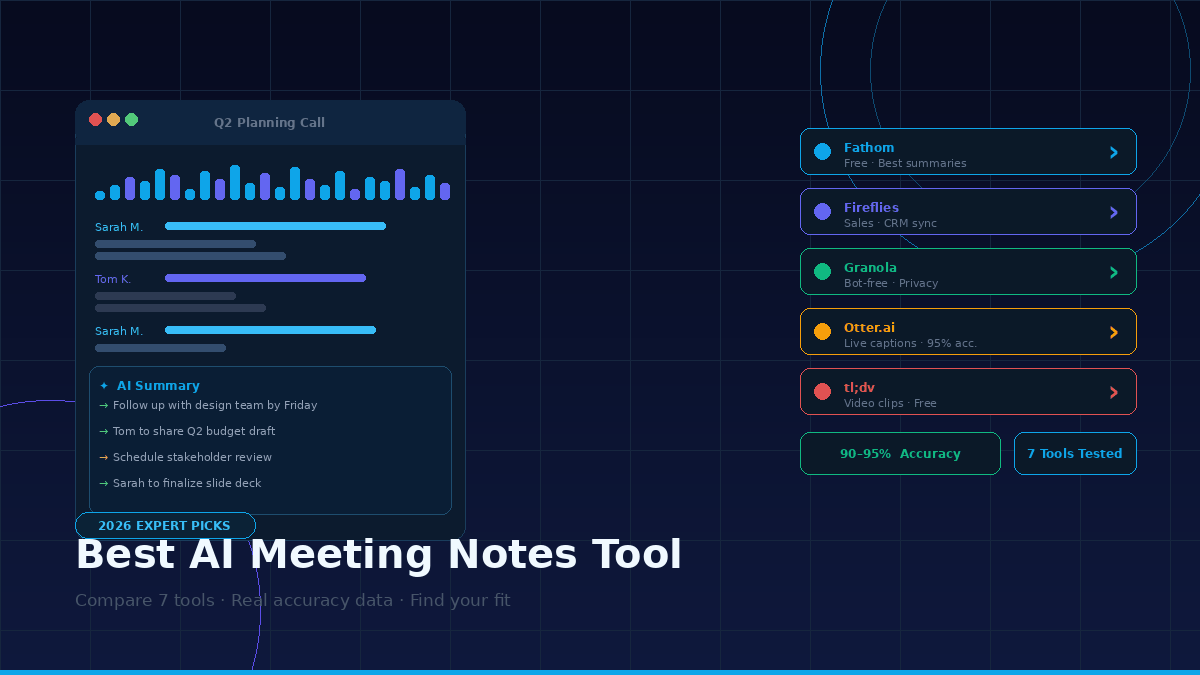
1. Fathom — Best Free Option Overall
Fathom has the most generous free tier in the category: unlimited recording, unlimited storage, unlimited AI summaries, no time cap, no credit card. Post-call processing typically completes in under 30 seconds — the summary is ready before you’ve closed your laptop.
In my testing, Fathom’s summaries consistently ranked among the most useful: structured sections (decisions, action items, key points) with less padding than competitors. The G2 rating sits at 5.0/5 from over 6,000 reviews, which is unusually high for any software category.
The limitations are real: Fathom is strongest on Zoom. Microsoft Teams and Google Meet support exists but feels like a second-class experience. CRM integration is lighter than Fireflies. Team collaboration features require the paid plan ($19/user/month).
Best for: Individuals and small teams on Zoom who want zero-cost, zero-friction note-taking with high-quality summaries.
Pricing: Free (unlimited personal); Team from $19/user/month.
2. Fireflies.ai — Best for Sales Teams and Integration Depth
Fireflies claims 75% Fortune 500 adoption, and the integration breadth makes it credible. The platform connects to 6,000+ tools — including Salesforce, HubSpot, Slack, Notion, Zapier, and most CRM platforms — making it the strongest choice for any team where meeting data needs to flow automatically downstream.
The standout 2026 addition is “Talk to Fireflies,” powered by Perplexity AI, which lets users search across their entire meeting history by topic or keyword. Ask “when did we last discuss pricing with Acme Corp?” and get a timestamped answer. For teams with deep meeting archives, this is genuinely useful.
Transcription accuracy in my testing landed around 90–93% — solid but slightly behind Otter in noisy, multi-speaker sessions. The “Fireflies Notetaker” bot is visible in every call.
Best for: Sales teams, customer success, and ops teams who need CRM auto-population and searchable meeting history.
Pricing: Free (800 min/month storage, unlimited transcription); Pro $10/user/month; Business $19/user/month.
3. Granola — Best Bot-Free Option for macOS
Granola captures system audio locally on your Mac without joining the call as a participant. Nobody in the meeting sees a bot. No recording indicator appears. For consultants, executives, therapists, and anyone whose meetings hinge on candor — this is the only architecture that doesn’t change the room.
The AI-enhanced notes are structured and clean. Accuracy is strong when audio is clear. The trade-offs are real: Mac-only as of early 2026, free tier history limited to 30 days, and paid plans start around $14/month for unlimited history and CRM integrations.
I found it particularly effective for external client calls and investor meetings where a visible bot would have signaled the wrong thing. The notes produced from those conversations were more honest — and more useful — than anything I got from bot-based tools in the same contexts.
Best for: Consultants, executives, sales professionals, therapists — anyone with client-facing calls where the presence of a bot creates friction.
Pricing: Free (30-day history); Paid from ~$14/month.
4. Otter.ai — Best for Real-Time Live Captions
Otter has been in this category longer than anyone, and it shows in one specific capability: real-time transcription during the meeting. While every other tool processes after the call, Otter streams a live transcript you can read mid-conversation — useful for accessibility, non-native speakers, or anyone who wants to catch a quote during the call without waiting for the post-meeting summary.
Transcription accuracy tested at approximately 94–95% — the highest in the category for multi-speaker English sessions. Otter’s AI agent features have improved significantly in 2025–2026 with stronger enterprise controls.
The honest criticism: the free tier has fallen badly behind. At 300 minutes per month, 30 minutes per conversation, and three lifetime file uploads, it feels dated compared to Fathom’s unlimited free tier. The $17/month Pro plan is hard to justify when Fathom provides comparable quality for free.
Best for: Accessibility use cases, large team meetings where real-time captions matter, multilingual environments.
Pricing: Free (300 min/month); Pro $17/month; Business $20/user/month.
5. tl;dv — Best Free Tier for Video Recording
tl;dv gives you unlimited free cloud recording and transcription — one of the few tools that matches Fathom’s generosity at zero cost. The standout feature is video clip creation: highlight a section of transcript, and tl;dv generates a shareable video clip of that moment. For sales coaching, UX research sharing, and async team communication, this is genuinely differentiated.
The free plan caps AI summaries at five per month, which limits its usefulness as a daily ai meeting notes tool unless you upgrade. Paid plans add unlimited AI features starting around $18/month per user.
Best for: Sales coaching, UX researchers, teams that share meeting clips asynchronously.
Pricing: Free (unlimited recording, 5 AI summaries/month); Pro ~$18/user/month.
6. Fellow — Best for Full Meeting Lifecycle
Fellow is the only tool in this roundup that handles the meeting before the call starts, not just after it ends. Structured agendas, collaborative note-taking during the meeting, and post-call AI summaries with action item tracking live in one place. The New York Times Wirecutter named it a top pick for meeting transcription and summarization.
The “Ask Fellow” AI agent drafts follow-up emails in Gmail based on actual meeting content and generates documents from notes. For teams that want one tool to replace both their meeting agenda software and their note-taker, Fellow is the only option that genuinely delivers both.
Enterprise security is a genuine differentiator: granular per-meeting permissions, centralized admin library, and support for Zoom, Google Meet, Teams, and Slack huddles.
Best for: Team leads, managers, and enterprises that want agenda-to-action-item workflow in one platform.
Pricing: Free (5 AI notes lifetime); paid plans from ~$7/user/month.
7. Jamie — Best for Privacy-First Bot-Free Teams
Jamie, like Granola, operates without a bot joining the call. The differentiation is cross-platform compatibility — Jamie works on any meeting platform including offline conversations, while Granola is Mac-only. The recent MCP integrations let Jamie’s notes flow directly into Claude, ChatGPT, and tools like Cursor and Windsurf — useful for developer and AI-heavy workflows. Not sure which of those to pipe your notes into? Our ChatGPT vs Claude vs Gemini comparison breaks down each.
Calendar sync (Google Calendar and Outlook), Notion integration, and 100+ language support round out the feature set. Pricing is shown in euros, which signals a European-first product — relevant for GDPR-sensitive deployments.
Best for: Privacy-conscious teams, hybrid/in-person meeting environments, developer workflows.
Pricing: Free plan available (100+ language support, core features); paid plans add more meetings.
Head-to-Head Comparison Table
| Tool | Best For | Bot Visible? | Free Tier | Paid Starts |
|---|---|---|---|---|
| Fathom | Individuals / Zoom | Yes | Unlimited | $19/user/mo |
| Fireflies | Sales / CRM integration | Yes | 800 min storage | $10/user/mo |
| Granola | Client calls / privacy | No | 30-day history | ~$14/mo |
| Otter.ai | Live captions / accuracy | Yes | 300 min/mo | $17/mo |
| tl;dv | Video clips / coaching | Yes | Unlimited recording | ~$18/user/mo |
| Fellow | Full meeting lifecycle | Yes | 5 AI notes lifetime | ~$7/user/mo |
| Jamie | Bot-free / multilingual | No | Core features | Paid plans vary |
How to Choose the Right Tool — A 3-Question Framework
Picking an AI meeting notes tool before answering these three questions is how you end up with a tool nobody uses after 30 days.
Question 1: Does a bot in your participant list create friction?
If yes — client calls, investor meetings, sensitive HR conversations — your list starts and ends with Granola or Jamie. Every other tool announces itself to every participant, which changes the nature of the conversation. I’ve watched sales discovery calls go noticeably colder the moment the prospect saw “Fireflies Notetaker” appear in the participant list.
If no — internal team standups, product reviews, sales calls with consenting participants — any bot-based tool works.
Question 2: Where does meeting data need to go after the call?
If the answer is “into Salesforce, HubSpot, or a CRM” — Fireflies or tl;dv leads on integration depth. If the answer is “into Slack and Notion” — most tools handle this adequately. If the answer is “into my email as a follow-up draft” — Fellow’s Ask Fellow agent is the only tool that does this natively.
Teams that don’t answer this question deploy tools that produce great summaries that nobody acts on. The notes exist; the follow-through doesn’t.
Question 3: What does your budget justify?
For individual contributors: Fathom’s free tier is genuinely hard to beat. Unlimited everything, high-quality summaries, no friction.
For teams: Fireflies at $10/user/month provides the best integration coverage. Fellow at ~$7/user/month provides the best lifecycle management.
For enterprise: Zendesk AI, Microsoft Copilot for Teams, or Avoma provide the compliance, admin controls, and SSO that enterprise IT requires — at enterprise pricing.
5 Mistakes That Kill AI Note-Taker Adoption
These patterns appear consistently across company sizes and meeting types. Recognizing them before deployment beats diagnosing them after.
Mistake 1: Choosing based on features instead of workflow fit. A tool with 6,000 integrations that doesn’t connect to the three tools your team actually uses is worse than a simpler tool that connects to all three. Map your workflow before evaluating features.
Mistake 2: Ignoring the bot visibility problem. Teams default to bot-based tools because they’re easier to set up. Then they wonder why external meeting participants mention it, why candor drops, or why a client asks whether the call is being recorded. This is a solvable problem — Granola and Jamie exist specifically for it.
Mistake 3: Treating the transcript as the deliverable. A raw 45-minute transcript is useless. The useful output is a structured action item list that someone acts on. If your team is pasting transcripts into email follow-ups manually, the tool isn’t deployed correctly.
Mistake 4: Skipping the CRM sync setup. Most sales teams deploy Fireflies or tl;dv, love the summaries for two weeks, then stop using the tool because action items never make it into Salesforce automatically. The integration setup takes 20 minutes. Skipping it negates most of the ROI.
Mistake 5: Using the free tier as a long-term solution when volume grows. Free tiers exist to get you hooked, not to run your team. Otter’s 300-minute monthly free cap and Granola’s 30-day history limit will both create friction at scale. Model your actual usage volume before committing.
Read More: Best AI Customer Support Tools: Expert Picks for 2026
Frequently Asked Questions
What is the best AI meeting notes tool for small teams? For small teams on a budget, Fathom is the clearest answer: unlimited free recording, unlimited AI summaries, and consistently high-quality output. If your team has more than five people and needs CRM sync, Fireflies at $10/user/month provides better workflow integration.
Do AI meeting note-takers work on Zoom, Teams, and Google Meet? Most bot-based tools support all three platforms, with varying quality. Fathom is strongest on Zoom. Otter and Fireflies have the broadest cross-platform coverage. Granola and Jamie work on any platform because they capture device audio rather than joining as a participant — the most reliable multi-platform approach.
How accurate is AI meeting transcription in 2026? For clean, single-speaker English audio, accuracy runs 90–95% across top tools. Real-world multi-speaker sessions with accents or technical vocabulary typically produce 85–92% accuracy. Otter.ai tested highest in noisy multi-speaker conditions at approximately 94–95%. The difference between the best and worst tools is narrower than vendor marketing suggests.
Is it legal to record meetings with an AI tool? In the US, most states require only one-party consent for recording — meaning recording your own meetings is generally legal. However, 11 states (including California, Florida, and Illinois) require all-party consent. For client-facing or external meetings, best practice is to inform participants that the call is being recorded. Tools that don’t announce themselves (Granola, Jamie) still require you to follow applicable recording consent laws.
What’s the difference between a bot-based and bot-free AI note-taker? Bot-based tools join your meeting as a visible participant and record the audio stream from the cloud. Bot-free tools (Granola, Jamie) capture system audio locally from the host’s device with no visible participant. Bot-free tools are preferred for sensitive, client-facing, or candor-dependent conversations. Bot-based tools generally offer deeper integrations and broader platform support.
Can AI meeting note-takers replace a human assistant? For routine note-taking, action item capture, and follow-up drafting — yes, reliably. For complex facilitation, real-time decisions, and relationship management — no. The most effective workflow pairs AI note-taking for documentation with human judgment for what to do with that documentation. Teams that eliminate the human judgment layer typically see note quality improve and follow-through stay flat.
Which AI meeting notes tool is best for sales teams? Fireflies is the strongest fit for most sales teams: automatic CRM population (Salesforce and HubSpot), talk-time analytics, cross-meeting search, and conversation intelligence at $10/user/month. tl;dv is a strong alternative for teams that prioritize video clip creation for coaching. Gong dominates enterprise sales intelligence use cases but at significantly higher price points.
How long does setup take? Fathom and tl;dv can be live in under 10 minutes — connect your calendar, authorize the platform, done. Granola installs as a macOS app in minutes. Fireflies and Otter require slightly more configuration to get CRM integrations working correctly, but a focused setup takes under an hour. Enterprise deployments with SSO, admin controls, and compliance requirements run longer.
Conclusion
The transcription problem is largely solved. Every tool on this list produces an accurate, searchable record of what was said. The meaningful differentiators in 2026 are three things: whether a bot announcing itself changes your meetings, where notes go after the call, and whether the tool you deploy actually gets used six months from now.
For most individuals: start with Fathom. It’s free, fast, and good enough to convert skeptics.
For sales teams: Fireflies earns its $10/seat with CRM depth no other tool matches at that price. Many of the same workflows that benefit from meeting capture also benefit from chatbots — see our AI chatbot for business guide for the lead-gen side.
For client-facing work: Granola is the only tool in the category that solves the presence problem without sacrificing quality.
Pick the tool that fits your most common meeting type, connect it to the two downstream tools your team actually uses, and measure containment weekly for the first 30 days. Everything else can scale from there.
The last full stop doesn’t mean the end—walk back through our main doors and let a new chapter find you.
