

Your content calendar doubled. Your team didn’t.
That’s the real problem most marketing teams face in 2026. And AI writing tools promise to fix it — but the market is flooded with options that look identical on a features page and perform very differently in real workflows.
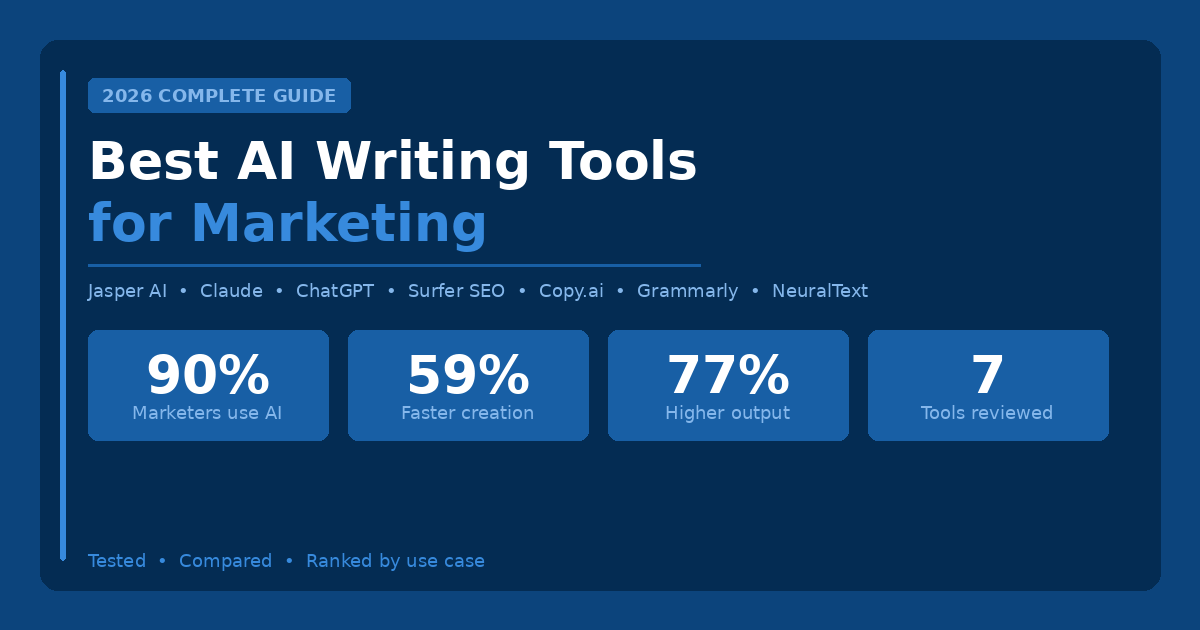
90% of content marketers now use AI writing tools, yet most “best of” lists just describe features without telling you what actually works. This guide is different. It covers the top tools tested against real marketing use cases — with honest assessments of strengths, weaknesses, pricing, and who each tool is actually built for.
What Are AI Writing Tools — And Why Marketers Need Them Now
AI writing tools are software platforms that use large language models (LLMs) to generate, edit, optimize, and repurpose written content. For marketers, they handle the high-volume, repetitive work — drafts, variations, ad copy, email sequences — so your team can focus on strategy and judgment.
The numbers back this up. Organizations using AI writing tools report 59% faster content creation and 77% higher output volume. That’s not a marginal gain. That’s the difference between a two-person content team competing with a ten-person operation.
But here’s the thing most articles skip: every marketing software vendor slapped “AI” on their homepage in 2024. Most of it was autocomplete with better branding. In 2026, the gap between tools that actually move metrics and tools that just look good in a demo has never been wider.
So the question isn’t whether to use AI writing tools. It’s which ones are worth your money.
The 7 Best AI Writing Tools for Marketing (Tested)
1. Jasper AI — Best for Marketing Teams at Scale
Jasper is the most purpose-built marketing writing tool on this list. Unlike general-purpose AI assistants like ChatGPT or Claude, Jasper is built specifically for marketing workflows — it includes brand voice management, marketing-specific templates, team collaboration features, and integrations with tools like Surfer SEO and HubSpot.
What it does well:
In my testing, Jasper’s Brand Voice feature is genuinely impressive. You paste in samples of your existing content, and it learns your tone. Every output after that sounds like your brand, not generic AI copy. For teams managing multiple clients or product lines, this alone justifies the price.
In direct comparisons for marketing-specific writing, Jasper produced the most conversion-focused copy — particularly for short-form ad content and product descriptions.
The honest limitations:
Jasper has a Surfer SEO integration that scores content as you write it — but without Surfer, Jasper’s base output requires manual SEO optimization. The integration adds cost since Surfer is a separate subscription.
Also worth knowing: Jasper uses a multi-LLM architecture in 2026 that includes GPT-4o (OpenAI), Claude (Anthropic), and Gemini (Google), routing tasks to the most appropriate model. You are partly paying for the layer Jasper built on top of those models — templates, workflows, brand settings — not for a fundamentally different AI.
Pricing: Jasper AI’s 2026 pricing starts at $39/month for the Creator plan (1 user, unlimited words), $59/month per user for the Pro plan (up to 5 users, brand voices, collaboration), and custom pricing for Business plans.
Best for: Marketing teams producing 20+ pieces of content per month who need brand consistency across writers.
2. Claude by Anthropic — Best for Long-Form and Nuanced Content
Claude is the strongest AI on this list for anything that requires depth, nuance, and a natural human voice.
Where ChatGPT excels at breadth, Claude excels at depth. I’ve found this to be accurate in practice. When writing a 3,000-word thought leadership article, Claude holds the thread of an argument across the entire piece better than any other tool I’ve tested. It doesn’t lose context. It doesn’t repeat itself. And it rarely produces the generic, watered-down prose that makes AI content feel hollow.
Claude consistently produces the most human-sounding content — it requires less humanization to pass AI detectors, and primary testing confirmed Claude as the winner for natural, engaging writing.
What it does well:
- Long-form blog posts and pillar content
- Brand voice matching when you provide strong examples
- Editing and rewriting existing drafts
- Nuanced messaging for complex products or regulated industries
The honest limitations:
Claude is not built specifically for marketing. There are no marketing templates, no built-in SEO scoring, and no team collaboration features out of the box. You need to bring your own workflow and prompts.
Pricing: Claude Pro starts at $20/month for individuals, $25/month for teams.
Best for: Solo marketers, content strategists, and writers who produce long-form content and are comfortable building their own prompts. For how Claude stacks up against ChatGPT and Gemini specifically, see our detailed ChatGPT vs Claude vs Gemini comparison.
3. ChatGPT — Best All-Around Tool for Versatility
86% of marketers report that ChatGPT is the most effective AI marketing tool they’ve used, according to a survey by the Digital Marketing Institute. That popularity is earned.
ChatGPT’s biggest advantage is range. It’s not locked into marketing templates. Need to analyze a spreadsheet of customer feedback? Upload it. Need to generate images or videos with Sora? ChatGPT has both natively.
What it does well:
- Fast drafting across all content types
- Data analysis combined with writing tasks
- Multimodal work — images, documents, spreadsheets
- Technical content and product documentation
The honest limitations:
ChatGPT isn’t solely a marketing tool. It’s a general-purpose AI that happens to be great at marketing if you know how to use it. Without a strong system prompt or custom instructions, outputs can feel generic. The tool also tends to forget your brand preferences between sessions unless you set up memory carefully.
Pricing: Free tier with limited GPT-4o access, ChatGPT Plus at $20/month, ChatGPT Team at $30/user/month, Enterprise pricing available.
Best for: Marketing generalists who need one tool for everything — copy, research, data, images, and ideation.
4. Surfer SEO — Best for Organic Search Optimization
Surfer isn’t a writing tool in the traditional sense. It’s an SEO optimization layer that tells you exactly what your content needs to rank.
The Content Editor provides real-time scoring as you write, analyzing your content against top-ranking competitors for your target keyword. It evaluates keyword density, semantic terms, heading structure, content length, and dozens of other ranking factors. The keyword clustering feature helps build topical authority by grouping related keywords into content hubs, aligning with how search engines now evaluate expertise.
What it does well:
The real-time content score is the standout feature. You write, and the score updates live. You can see exactly which semantic keywords are missing, whether your headings are structured correctly, and how your word count compares to the top 10 results. It removes the guesswork from SEO content.
The honest limitations:
Surfer doesn’t write content well on its own. Surfer’s AI doesn’t write for you in the same way Jasper does — it structures and scores. The two tools are often used together. Treat it as a co-pilot, not a solo writer.
Pricing: Discovery plan starts around $49/month.
Best for: SEO specialists and content marketers focused on organic search who want data-driven guidance while writing.
5. Copy.ai — Best for Short-Form Ad and Social Copy
Copy.ai is purpose-built for the short end of the content spectrum — ads, social posts, email subject lines, product descriptions, and CTAs.
For ads and social content, it’s efficient. Don’t expect it to write comprehensive blog posts. If you’re deciding between these two tools specifically, our Jasper vs Copy.ai comparison breaks down exactly where each one wins.
What it does well:
The speed is real. For generating 10 Facebook ad variations or 20 Instagram caption options, Copy.ai is faster than any other tool here. The output quality for short-form copy — punchy, conversion-focused, varied — is consistently strong.
The honest limitations:
Long-form content is noticeably weaker. Blog posts feel thin and repetitive. If your primary output is articles and pillar content, look elsewhere.
Best for: Performance marketers and paid social teams who need high-volume short-form copy at speed.
6. Grammarly — Best for Editing and Brand Consistency
Grammarly has evolved well beyond spell-check. In 2026, it functions as a full writing assistant that catches tone issues, clarity problems, passive voice, and consistency errors across your entire content operation.
Most successful content teams use 2–3 tools: a general-purpose AI writer (ChatGPT or Claude), a specialized tool for their main use case (SEO, ads, or email), and Grammarly for editing.
What it does well:
The browser extension integrates with almost every platform you already use — Google Docs, HubSpot, WordPress, Notion, Slack. It catches the errors that make AI-generated content feel amateur: overused phrases, inconsistent tone, vague language, and run-on sentences.
The honest limitations:
Grammarly is an editing tool, not a generation tool. It makes existing content better — it doesn’t create from scratch. Think of it as the final quality gate in your workflow, not the starting point.
Best for: Every marketing team, without exception. This belongs in your stack regardless of what else you use. If the $30/month price gives you pause, there are several strong Grammarly alternatives worth comparing first.
7. NeuralText — Best for SEO-Focused Content Strategy
NeuralText is an AI writing tool that guides you through every step of generating content — from in-depth SEO prep through to final creation. It starts with your topic, runs a search on top-ranking examples for related keywords, and handles all the heavy lifting on SEO analysis. Long-tail keyword discovery, keyword clustering, strategy suggestions, content briefs with H1 and H2 suggestions, target word count and SEO score, and suggested People Also Ask questions for FAQ sections are all built into the workflow.
Best for: SEO strategists who want a single platform to handle research, briefs, and content creation together.
How to Choose the Right AI Writing Tool for Your Team
The biggest mistake marketers make is searching for one perfect tool. It doesn’t exist.
The marketers seeing the most gain from AI are those treating it as production infrastructure — it handles the volume work so the team can focus on the decisions that actually require thinking.
Here’s a practical framework:
Step 1: Identify your primary content bottleneck. Is it long-form blog production? Short-form ad copy? SEO optimization? Email sequences? Each has a best-fit tool.
Step 2: Match tool to use case, not reputation. ChatGPT is the most popular tool used in content marketing workflows — but popularity doesn’t mean it’s right for your specific situation.
Step 3: Start with two tools, not six. One general-purpose writer (Claude or ChatGPT) plus one specialized tool (Surfer for SEO, Copy.ai for ads, Grammarly for editing). Master those before adding more.
Step 4: Run your own test before committing. Free trials matter — test with your real content data before paying. Every marketing software vendor has a polished demo. What matters is how the tool performs on your actual use cases.
Common Mistakes Marketers Make with AI Writing Tools
Mistake 1: Using AI output without editing
AI-generated content still needs editorial review. The tools produce volume. You provide judgment. Treating AI output as final copy is the fastest way to publish content that sounds mechanical and ranks poorly.
Mistake 2: Choosing a tool based on price alone
Nearly every dedicated AI writing tool — Jasper, Writesonic, Copy.ai, Rytr, Anyword — runs on OpenAI’s GPT models or Anthropic’s Claude models. They are not building their own AI. They are calling the same APIs you could access directly. What you’re paying for is the layer built on top: templates, brand memory, workflow automation, SEO integrations. That layer is valuable in specific situations — and not worth paying for in others. Know what you’re actually buying.
Mistake 3: Expecting AI to replace strategy
AI handles high-volume, repetitive tasks well: generating variations, drafting outlines, and rewording and repurposing existing content. Strategic decisions, brand positioning, creative direction, and audience understanding still require human judgment. Marketers who understand this distinction get dramatically better results than those who try to fully automate their content.
Mistake 4: Using too many tools at once
More tools create more context-switching, more learning curves, and more inconsistency in brand voice. One strong general-purpose tool plus one specialist tool beats a stack of six mediocre integrations every time.
Mistake 5: Ignoring the prompt quality
The output is only as good as the instruction. A vague prompt produces vague content. A well-structured prompt with audience definition, tone guidance, specific angle, and word count produces content that needs minimal editing. Invest time in building a prompt library for your most common content types.
AI Writing Tools Pricing Comparison (2026)
| Tool | Starting Price | Best Use Case | Free Tier? |
|---|---|---|---|
| Jasper AI | $39/month | Marketing teams, brand voice | Yes (trial) |
| Claude Pro | $20/month | Long-form, nuanced writing | Yes (limited) |
| ChatGPT Plus | $20/month | General purpose, versatile | Yes (limited) |
| Surfer SEO | $49/month | SEO content optimization | No |
| Copy.ai | Free tier available | Short-form ad copy | Yes |
| Grammarly | Free tier available | Editing, consistency | Yes |
| NeuralText | Varies | SEO strategy + briefs | Trial available |
FAQs
What is the best AI writing tool for marketing in 2026?
There is no single best tool — it depends on your use case. For long-form content, Claude is the strongest option. For marketing-specific templates and brand voice, Jasper leads. For versatility, ChatGPT is hard to beat. Most effective teams use two to three tools in combination rather than relying on one platform for everything.
Is AI-generated content bad for SEO?
Not inherently. Google’s guidance focuses on content quality and helpfulness, not the method of creation. AI-generated content that is accurate, well-edited, and genuinely useful to readers performs well in search. The problem is unedited, low-effort AI content — not AI content in general. Pair AI generation with Surfer SEO and human editorial review for the best organic results.
Can AI writing tools replace human copywriters?
No — at least not the strategic and creative work. AI handles high-volume, repetitive tasks well: generating variations, drafting outlines, repurposing content. Strategic decisions, brand positioning, and creative direction still require human judgment. AI is best treated as a production assistant, not a replacement for experienced marketers.
How much do AI writing tools cost for a small marketing team?
A practical stack for a small team costs roughly $50–$100/month. That covers Claude or ChatGPT Plus ($20/month) plus Grammarly Business or Surfer SEO for your primary use case. Jasper Pro runs $59/user/month and is better justified for larger teams producing consistent high volumes.
Which AI tool writes the most human-sounding content?
Claude consistently produces the most human-sounding content, requiring less editing to feel natural and pass AI detection checks. For short-form persuasive copy, Jasper produces the most conversion-focused output. The gap between tools narrows significantly when you apply strong prompts and a good editing pass.
Is Jasper AI worth the price compared to ChatGPT?
For small marketing teams producing high volumes of content, Jasper AI can be worth it — particularly the Creator plan at $39/month. However, teams producing fewer than 20 pieces of content per month may find the cost hard to justify compared to using ChatGPT or Claude directly with custom prompts.
What AI writing tools do professional marketing agencies use?
For content teams, the practical stack is: Jasper for drafting at scale, Surfer SEO for optimization, Canva for visual assets, and Creatify if video ads are part of the content mix. Most agencies also use Grammarly across all written output as a baseline quality layer.
Do AI writing tools work for email marketing?
Yes, and this is one of the strongest use cases. AI tools excel at generating subject line variations, email body copy, and A/B test variants at volume. ChatGPT and Claude both handle email copy well. For a deeper look, see our roundup of the best AI email writing tools.
Conclusion
The AI writing tool market in 2026 is mature, competitive, and full of tools that look similar on paper but perform very differently in practice.
Here’s the clearest decision framework based on everything covered in this guide:
- You’re a solo marketer or freelancer → Start with Claude Pro or ChatGPT Plus at $20/month. Add Grammarly free tier. That’s a complete stack under $25/month.
- You run a content team producing 20+ pieces per month → Jasper Pro plus Surfer SEO is the combination that produces the most consistent, brand-aligned, SEO-ready output.
- You run paid social or performance marketing → Copy.ai for ad variations, ChatGPT for broader creative strategy.
- SEO is your primary growth channel → Surfer SEO is non-negotiable. Pair it with Claude or ChatGPT for generation.
The one thing every marketer should internalize: AI writing tools are a competitive necessity in 2026, not a nice-to-have. The question is no longer whether to use them. It’s whether you’re using them strategically — or letting your competitors do it better.
Pick one tool from this list, run a real test on your actual content for two weeks, and measure the output quality honestly. That single step will tell you more than any feature comparison.
Good things come to those who read—find yours in our signature selection and level up instantly.
