

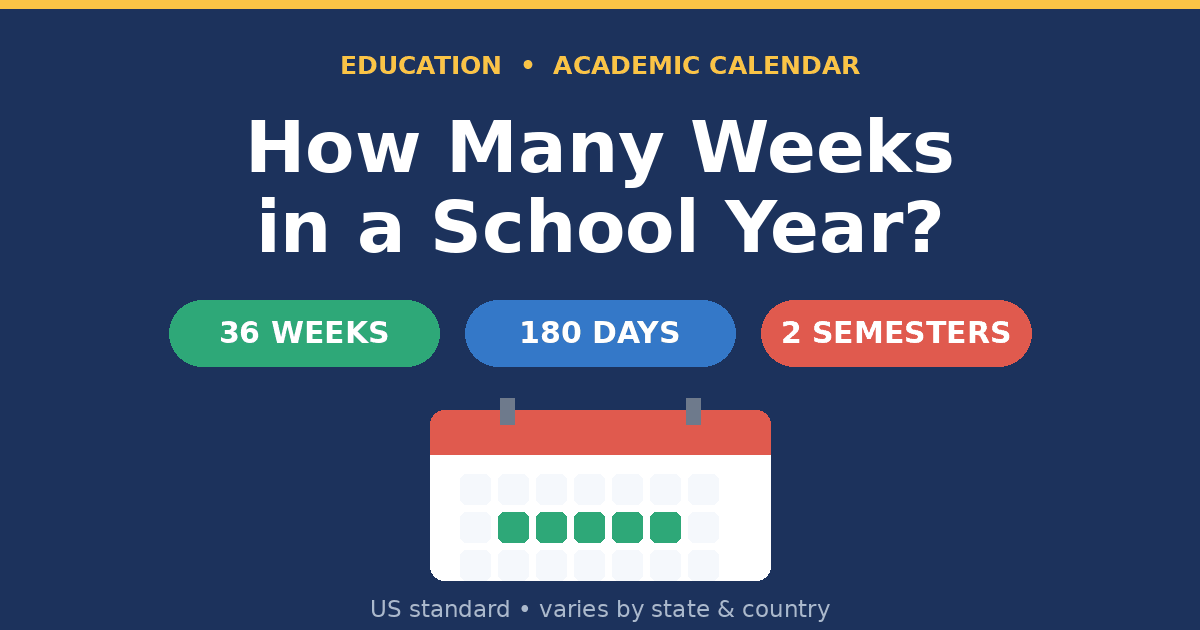
A typical US school year runs about 36 weeks, or roughly 180 school days. In the UK, it’s closer to 39 weeks. That’s the quick answer if you came here in a hurry.
But that single number hides a lot. The “36 weeks” a teacher counts isn’t the same as the 40-plus calendar weeks a parent sees between the first day and the last. Different countries, states, and even private schools all land on different totals.
I’ve spent years working around academic calendars, and the confusion almost always comes from mixing up instructional weeks with calendar weeks. This guide clears that up. You’ll get the exact figures by country, a simple way to calculate your own school’s total, and the breaks that make the math messy.
The Short Answer: How Many Weeks Is a School Year?
For most students in the United States, a school year is 36 weeks of actual instruction. That comes from the 180-day requirement most states set, divided by a five-day school week.
The UK runs longer at about 39 weeks, and Australia sits around 40 weeks. Across developed countries, the OECD average lands between 38 and 40 weeks.
Here’s the catch that trips people up. Those numbers count teaching weeks only. They leave out summer break, winter and spring holidays, and public holidays. Count from the first day of term to the last and you’ll see closer to 40 to 42 calendar weeks, even in a “36-week” system.
So the right answer depends on what you’re actually counting: time in class, or time on the calendar.
How Many Weeks in a School Year by Country
The biggest reason people get different answers is simple — they’re looking at different countries. Education calendars aren’t standardized globally, and even within one country they shift by region.
Here’s how the major English-speaking systems compare.
| Country | Instructional weeks | School days | Term structure |
|---|---|---|---|
| United States | ~36 weeks | ~180 days | 2 semesters / 4 quarters |
| United Kingdom | ~39 weeks | ~190 days | 3 terms |
| Canada | ~36–40 weeks | ~180 days | 2–3 terms |
| Australia | ~40 weeks | ~200 days | 4 terms |
| India | ~40+ weeks | ~200+ days | varies widely |
The United States keeps things fairly rigid at 180 days, which works out to 36 weeks. Start dates are the real variable: southern states often begin in early August, while northern states wait until after Labor Day in September.
The United Kingdom runs a longer 39-week year split into three terms — autumn, spring, and summer. Each term has a short one-week “half-term” break in the middle to stop students and teachers from burning out.
Australia flips the calendar entirely. Its 40-week year runs from late January to mid-December across four terms, because the seasons are reversed in the Southern Hemisphere.
How to Calculate Your Own School Year
Don’t rely on a generic number when your district publishes its exact calendar. You can work out your real total in about two minutes.
Step one: Find your school’s official start and end dates. These are almost always on the district or school website under “academic calendar.”
Step two: Count the total weeks between those two dates. A start of late August and an end of early June gives you roughly 40 to 42 calendar weeks.
Step three: Subtract the breaks. Take out summer overlap, the winter holiday (usually two weeks), spring break (one week), and any half-terms or long weekends.
What’s left is your true instructional total, and for most US schools it lands right back at that familiar 36 weeks. The reason this matters: planners, tutors, and parents budgeting for childcare need the calendar weeks, while the 180-day figure is what the state actually mandates.
A quick shortcut for the US: 180 days ÷ 5 days per week = 36 weeks. For the UK: 190 days ÷ 5 = 38 weeks of pure teaching, which rounds up to 39 once you account for partial weeks.
Common Misconceptions About School Year Length
A handful of myths cause most of the confusion. Clearing them up makes every other number click into place.
180 days means 180 weeks of something. No. The 180 refers to instructional days, not weeks. Divided across a five-day week, that’s 36 weeks. People who multiply or misread this number end up wildly off.
Every state has the same school year. Not true. While 180 days is the common benchmark, states set their own rules, and some measure by total instructional hours instead of days. That lets a few districts run fewer, longer days.
Private schools follow the same calendar. Often they don’t. Private schools aren’t always bound by state mandates and sometimes run a shorter year, in the range of 32 to 34 weeks.
Year-round school means more days. Usually not. Year-round calendars typically still hit the same 180 days. They just spread them out, swapping the long summer break for several shorter breaks across the year.
The school year keeps shrinking. The instructional requirement has stayed remarkably steady at around 180 days for decades. What changes is the start date and how breaks are arranged, not the core total.
Read More: How to Stop Overthinking at Night: 7 Proven Techniques
Frequently Asked Questions
How many weeks are in a US school year? A standard US school year is about 36 weeks of instruction, based on the 180-day requirement most states mandate. Counting from the first to the last day on the calendar, including all breaks, the academic season usually stretches to around 40 weeks.
How many weeks in a school year without holidays? Without holidays, a US school year is roughly 36 weeks of pure teaching time. Add back the five major break periods — summer overlap, winter, spring, and shorter holidays — and the full calendar span grows to about 40 to 42 weeks from start to finish.
How many weeks is a UK school year? The UK school year is about 39 weeks, or roughly 190 student days. It splits into three terms: autumn lasts around 13 weeks, spring around 12, and summer around 14. Each term includes a one-week half-term break in the middle.
How many school days are in a year? Most US states require 180 school days per year, which equals 36 five-day weeks. The UK runs about 190 days, Australia roughly 200, and the global OECD average falls between 180 and 200 instructional days depending on the country.
Why is a school year 180 days? The 180-day standard emerged from decades of US state policy aiming to balance enough instructional time with breaks, teacher planning, and family schedules. It’s a benchmark, not a federal law, so individual states and districts can and do adjust it slightly.
How many weeks are in a semester? A typical US semester runs about 18 weeks, since the 36-week year divides into two equal halves. Many schools further split each semester into two 9-week quarters, creating four marking periods across the full academic year.
Is one school year really 12 months? No. A school year spans about 10 months of calendar time, usually late August or September through May or June. The remaining two to three months make up the summer break, which is why the academic year and the full calendar year don’t line up.
Final Thoughts
So, how many weeks in a school year? For the US it’s about 36 weeks of teaching inside a roughly 40-week calendar span. The UK runs 39, Australia 40, and the global average sits between 38 and 40.
The trick is knowing which number you need. If you’re planning instruction, count the 180 days. If you’re planning childcare, holidays, or a tutoring schedule, count the calendar weeks and subtract the breaks.
The best move is always to pull your own district’s published calendar and run the quick subtraction above. It takes two minutes and gives you the exact answer for your school, not just the national average.
For more clear, practical guides on education, lifestyle, and everyday questions, explore Vents Magazine.
