

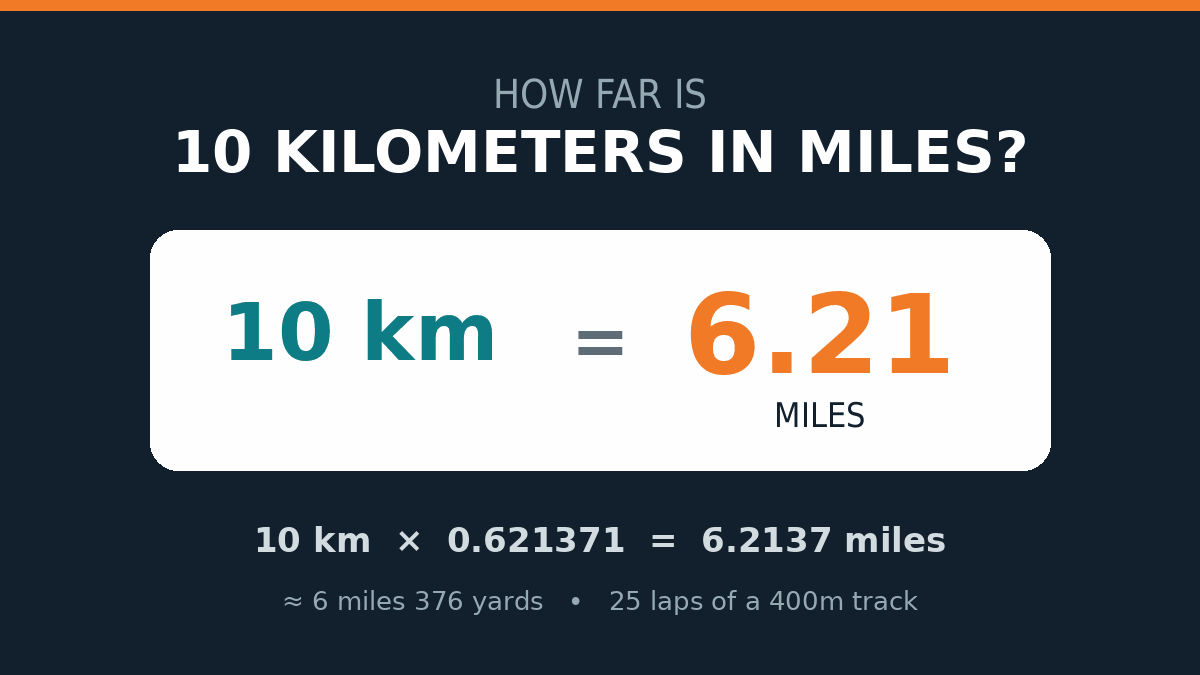
A 10km run is 6.21 miles. More precisely, 6.2137 miles, or about 6 miles and 376 yards.
That’s the answer if you came here in a hurry. But if you’re staring at a race registration page wondering whether you can actually cover that distance, the number alone won’t help much. I’ve coached enough first-timers to know the real question hiding behind “how far is 10km in miles” is usually: is this far, and can I do it?
Short version: it’s manageable. A 10K is the sweet spot between a casual 5K and a half marathon. This guide gives you the exact conversion, a pace chart so you can predict your finish time, average finish times by age, and a training plan that’s gotten plenty of beginners across the line.
What 10km Equals in Miles (The Exact Numbers)
The clean way to remember it: 10 kilometers is about 6.2 miles. For everyday use, 6.2 is all you need.
If you want the precise figure, 10km converts to 6.2137119 miles. The conversion factor is fixed: one kilometer equals 0.621371 miles. So you multiply the kilometers by 0.621371 and you’ve got your answer.
Here’s the math written out:
10 km × 0.621371 = 6.21371 miles
You can also flip it. One mile is 1.609 kilometers, so to go the other way you’d divide. A 10K on a standard 400-meter outdoor track works out to exactly 25 laps, which is a useful mental picture if you’ve ever done speed work at a school track.
People write this distance a few different ways, and they all mean the same thing: “10K,” “10km,” “10 kilometers,” and “10,000 meters” are identical. A race labeled any of those is the same 6.2 miles.
Quick conversion table for common race distances:
| Race | Kilometers | Miles |
|---|---|---|
| 5K | 5 km | 3.11 mi |
| 10K | 10 km | 6.21 mi |
| 15K | 15 km | 9.32 mi |
| Half marathon | 21.1 km | 13.1 mi |
| Marathon | 42.2 km | 26.2 mi |
Notice the 10K sits right in the middle of the pack. It’s double a 5K and just under half a half marathon. That positioning is exactly why so many runners use it as a stepping stone.
How to Convert Kilometers to Miles Yourself
You don’t need an app for this. There’s a shortcut that gets you close enough for any practical purpose.
The lazy method: multiply kilometers by 0.6. So 10km becomes roughly 6 miles. It undershoots slightly, but for a rough estimate while you’re scrolling a race website, it’s fine.
The accurate method: multiply by 0.621371. That gives you 6.21 miles for a 10K, which is the number you’d want for setting real pace goals.
I tell the runners I coach to memorize a couple of anchor points instead of doing math every time:
- 5K is about 3.1 miles
- 10K is about 6.2 miles
- Half marathon is about 13.1 miles
Once those three live in your head, you can estimate almost any distance by adding or halving. Training for an 8K? It’s between a 5K and a 10K, so somewhere around 5 miles. Close enough to plan around.
The reason the conversion isn’t a round number is that the mile and the kilometer come from completely different measurement systems. The mile is part of the imperial system used mainly in the US and UK. The kilometer belongs to the metric system that most of the world runs on. A mile is exactly 1,609.344 meters, which is why the decimals never land cleanly.
How Long Does It Take to Run a 10K?
This is where the conversion stops being trivia and starts mattering. Most people finish a 10K somewhere between 50 minutes and 1 hour 15 minutes. Beginners often land closer to 70 to 80 minutes, and that’s completely normal.
Your finish time comes down to your pace per mile. Here’s a pace chart I hand out so runners can see exactly what they’re signing up for:
10K pace chart (miles):
| Pace per mile | 10K finish time |
|---|---|
| 7:00 | 43:30 |
| 8:00 | 49:42 |
| 9:00 | 55:55 |
| 10:00 | 1:02:08 |
| 11:00 | 1:08:19 |
| 12:00 | 1:14:33 |
| 13:00 | 1:20:46 |
If you can comfortably hold a 10-minute mile, you’re looking at roughly a one-hour 10K. That’s a realistic target for someone who’s been running consistently for a few months. Don’t get discouraged if a 12 or 13-minute mile is where you are right now. Plenty of people finish their first 10K with walk breaks built in, and a finish is a finish.
One thing I always flag to first-timers: your training pace and your race pace won’t match. Race-day adrenaline, a crowd around you, and a course that’s measured properly all tend to pull you a little faster than your solo training runs. Build your plan around your honest training pace, then let race day surprise you.
Average 10K Finish Times by Age and Gender
It helps to know where you stack up, but treat these as reference points, not report cards. Data compiled across large samples of recreational runners gives a rough picture of average finish times by age group.
Across all ages and genders worldwide, a “good” recreational 10K time averages around 49 to 50 minutes for men and just under an hour for women. But averages flatten out a lot of useful detail, so here’s the breakdown by age:
Approximate average 10K finish times:
| Age group | Men | Women |
|---|---|---|
| 16–19 | ~46–47 min | ~1:00 |
| 20–29 | ~52–53 min | ~1:00–1:02 |
| 30–39 | ~54 min | ~1:02 |
| 40–49 | ~54–55 min | ~1:03 |
| 50–59 | ~57–59 min | ~1:05–1:08 |
| 60+ | ~59 min–1:03 | ~1:10+ |
What I want you to take from this table isn’t the specific minute. It’s that age barely moves the needle as much as people fear. A fit 55-year-old regularly beats an untrained 25-year-old. Consistency in training matters far more than the number on your birth certificate.
The 10K is also one of the most popular race distances on the planet. In the US alone, it draws over 4 million finishers a year, second only to the 5K. So when you toe the start line, you’re in very crowded, very friendly company.
How to Train for Your First 10K
Going from couch to 10K, or from 5K to 10K, takes most people about 8 weeks. You don’t need to live at the gym. You need a plan that adds distance slowly enough that your body keeps up.
The single biggest mistake I see is doing too much too soon. Tendons and joints adapt slower than your heart and lungs do. You’ll feel ready to run farther before your legs are structurally ready, and that gap is where injuries happen.
A simple 8-week framework:
In the early weeks, run or run-walk three times a week, keeping your longest run around 3 to 4 km. Through the middle weeks, push your long run out to 5, then 6, then 7 km while keeping your other two runs short and easy. By weeks 7 and 8, your long run should touch 8 to 9 km, which makes race-day 10K feel familiar rather than terrifying.
A few rules that keep people healthy:
Increase your weekly distance by no more than about 10% at a time. This is the oldest guideline in running for a reason. It’s slow on purpose.
Keep most of your runs easy. You should be able to hold a conversation. If you’re gasping on every run, you’re training too hard and you’ll burn out or get hurt.
Take rest days seriously. Rest is when your body actually gets stronger. Skipping recovery doesn’t make you tougher, it just makes you tired.
Strength work helps too. Squats, lunges, and core exercises a couple of times a week build the muscle endurance that carries you through the back half of a 10K, when form tends to fall apart.
Common 10K Mistakes and Myths
A few misconceptions trip up almost every beginner. Clearing them up early saves a lot of grief.
Myth: A 10K is basically a marathon. Not even close. A marathon is 26.2 miles, more than four times a 10K. The training, fueling, and recovery demands are in a different universe. A 10K is approachable for a regular person in two months. A marathon is a season-long commitment.
Mistake: Starting the race too fast. The most common race-day error. The first kilometer feels easy and you fly out with the crowd, then you’re cooked by the halfway point. Start slower than feels natural and pass people in the second half. It feels better and it’s faster overall.
Mistake: Ignoring hydration until race week. Hydration is a daily habit, not a race-morning fix. Drink consistently in the days leading up, not just the morning of.
Myth: You need to run the whole thing. You don’t. Run-walk strategies finish 10Ks every single weekend. Walking through aid stations or taking planned walk breaks is a legitimate, smart way to run your first one.
Mistake: Buying brand-new shoes the night before. Race in shoes you’ve already broken in. New shoes on race day are how you discover blisters at mile four.
Read More: Proven Best Times to Drink Water for Weight Loss
FAQs
How many miles is a 10K run? A 10K run is 6.21 miles, or 6.2137 miles to be exact. The conversion factor is 0.621371, so you multiply 10 kilometers by that number. For everyday planning, just remember that a 10K is a little over 6 miles.
Is 10km a long way to run? For a beginner, 10km feels long at first, but it’s very achievable with about 8 weeks of training. It’s considered a moderate distance, harder than a 5K but far easier than a half marathon. Most healthy adults can train up to it safely.
How long does it take to walk 10km? Walking 10km takes most people about 1 hour 40 minutes to 2 hours at a normal pace of 3 to 4 miles per hour. A brisk walker covering a 15-minute mile would finish in roughly 1 hour 33 minutes. Terrain and fitness change this significantly.
What is a good 10K time for a beginner? A good beginner 10K time is anywhere from 60 to 80 minutes. Finishing at all on your first attempt is the real win. As you build consistency, breaking the one-hour mark becomes a satisfying next goal for most recreational runners.
How many steps are in a 10K? A 10K is roughly 12,000 to 15,000 steps, depending on your stride length and height. Shorter runners take more steps; taller runners take fewer. Running generally produces a longer stride than walking, so you’ll cover the distance in fewer steps when running.
Is running a 10K every day good for you? Running 10K every day is too much for most people and raises injury risk sharply. Your body needs rest days to adapt and repair. Three to five runs a week, mixing distances and including recovery, builds fitness more safely than daily hard efforts.
How far is 10km in miles compared to a 5K? A 10K (6.21 miles) is exactly double a 5K (3.11 miles). If you’ve already run a 5K, the 10K is the natural next step. The jump feels big on paper but is very doable once you extend your long runs gradually.
Final Takeaway
So, how far is 10km in miles? It’s 6.21 miles — a distance that’s challenging enough to feel like an accomplishment and short enough that almost anyone can train for it in two months.
If a number is all you needed, you’ve got it. But if you’re eyeing a race, the better question is when do you start training? Pick a 10K eight to ten weeks out, map your long runs onto the framework above, and build slowly. The conversion is the easy part. Showing up three times a week is what actually gets you to the finish line.
Small reads, big impact—tap into our power picks and change the way you see things.
