






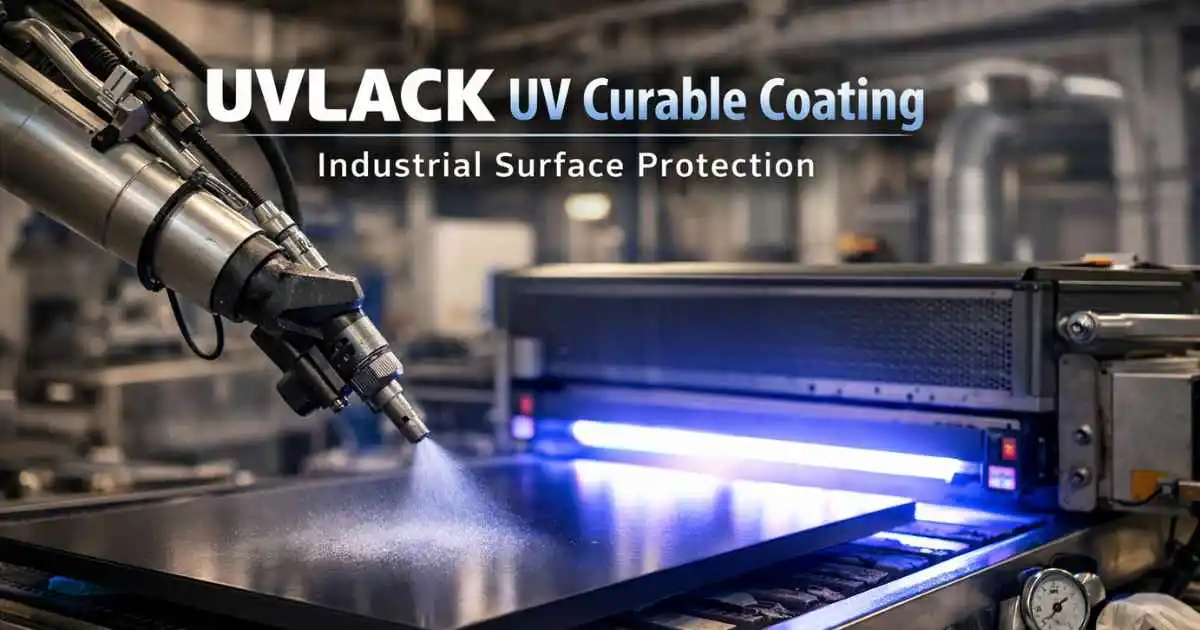
Modern industries rely on surface coatings not only for appearance but for structural durability and long-term performance. In sectors such as automotive, packaging, electronics, and furniture manufacturing, the coating layer directly impacts resistance to wear, moisture, chemicals, and environmental stress. A high-quality coating reduces maintenance costs and enhances product lifespan, making it a strategic component of modern manufacturing.
Traditional solvent-based coatings often require extended drying periods and may produce higher emissions. These limitations slow production cycles and create environmental compliance challenges. As production systems move toward automation and lean efficiency, faster and cleaner curing technologies become essential.
UVLACK is engineered to address these industrial demands through ultraviolet-triggered polymerization. It transforms from liquid to solid within seconds, forming a durable and stable protective layer that supports high-speed manufacturing without compromising surface integrity.
Scientific Foundation and Curing Technology
Photopolymerization Mechanism
UVLACK cures through a controlled photopolymerization process. When exposed to ultraviolet radiation, photoinitiators absorb light energy and trigger a molecular cross-linking reaction. This reaction creates a dense three-dimensional polymer network that strengthens the coated surface almost instantly.
Unlike evaporation-based drying systems, UV curing does not depend on ambient temperature or humidity. The intensity and duration of light exposure determine hardness and cure depth, allowing consistent and repeatable results across production batches. This level of control improves reliability and reduces finish inconsistencies.
The balanced cross-linked structure provides rigidity for protection while maintaining flexibility to prevent cracking. This structural harmony ensures long-term resistance to physical stress and environmental exposure.
Formulation Structure
The formulation integrates structural resins for strength, reactive diluents for controlled viscosity, photoinitiators for rapid activation, and stabilizers for environmental resistance. Surface modifiers improve leveling and minimize application defects.
Each component serves a functional role in enhancing adhesion, smoothness, and durability. The result is a coating system capable of uniform curing and dependable performance across compatible materials.
Mechanical Durability and Protection Performance
Abrasion and Impact Resistance
Industrial surfaces face continuous friction, stacking pressure, and mechanical handling. UVLACK forms a hardened protective barrier that distributes stress evenly across the surface. This reduces localized damage and preserves appearance over time.
Enhanced abrasion resistance is especially valuable for packaging materials, decorative panels, cabinetry, and automotive interiors. By minimizing scratches and scuffs, it extends product lifespan and lowers maintenance requirements.
Impact tolerance further strengthens surface stability, preventing peeling or cracking under moderate operational stress.
Chemical and Environmental Stability
Surfaces must also resist chemical exposure, moisture, and temperature changes. UVLACK acts as a protective shield against cleaning agents, oils, and environmental contaminants. This reduces substrate degradation and improves long-term reliability.
Integrated stabilizers help maintain gloss retention and reduce fading from light exposure. Temperature stability ensures consistent performance in varying industrial conditions.
Protective qualities include resistance to common chemicals, moisture barrier performance, long-term gloss stability, and maintained surface clarity.
Production Efficiency and Operational Benefits
Rapid Curing and Throughput Enhancement
One of the strongest advantages of UVLACK is its rapid curing speed. Traditional coatings may require hours to dry, limiting production output. UV curing completes within seconds, allowing immediate handling and downstream processing.
This acceleration supports continuous manufacturing systems and reduces bottlenecks. Shorter curing cycles also lower contamination risks before the surface hardens.
Operational advantages include higher throughput, reduced storage needs, improved scheduling flexibility, and enhanced production consistency.
Energy and Cost Efficiency
UV curing systems deliver energy in short exposure bursts rather than prolonged heating cycles. This reduces overall energy consumption while maintaining strong performance characteristics.
Lower energy use combined with faster processing decreases labor time and rework rates. Improved equipment utilization supports better return on investment and scalable production growth.
Performance Comparison Overview
| Feature | UVLACK (UV-Curable) | Traditional Solvent Coating |
|---|---|---|
| Curing Time | Seconds | Several Hours |
| Energy Usage | Low | Moderate to High |
| VOC Emissions | Minimal | Higher |
| Abrasion Resistance | High | Moderate |
| Production Speed | Very Fast | Limited by Drying |
| Surface Consistency | Controlled | Environment Dependent |
This comparison demonstrates the operational and environmental advantages of UV-curable coating systems.
Material Compatibility and Industry Applications
Substrate Versatility
UVLACK is compatible with engineered wood, printed paperboard, thermoplastics, decorative metals, and composite panels when proper preparation is applied. Uniform thickness and calibrated exposure ensure strong adhesion and complete curing.
This adaptability allows manufacturers to standardize finishing processes across multiple product categories while maintaining reliable performance.
Industrial Applications
In printing, UV-curable coatings protect ink clarity and prevent smudging. Packaging industries use them to improve durability and shelf appeal. Automotive manufacturers apply them to interior components for long-term wear resistance. Furniture producers rely on enhanced abrasion resistance to preserve finish quality.
The electronics sector benefits from protective barriers that reduce exposure to dust and humidity, demonstrating cross-industry flexibility.
Environmental Responsibility and Sustainability
Reduced Emissions
UV-curable systems significantly reduce solvent emissions because curing occurs through polymerization instead of evaporation. This improves indoor air quality and supports regulatory compliance.
Cleaner production processes enhance workplace safety and align with sustainability initiatives.
Long-Term Environmental Impact
Energy-efficient curing lowers carbon impact compared to heat-based systems. Increased durability reduces the need for refinishing or material replacement, conserving resources.
Sustainability benefits include reduced atmospheric emissions, lower energy consumption, extended product lifespan, and decreased material waste.
Quick Summary
UVLACK is a UV-curable coating system that transforms from liquid to solid within seconds through photopolymerization. It offers rapid curing, high abrasion resistance, low VOC emissions, and energy efficiency compared to traditional solvent-based coatings.
Key Features of UVLACK
- Rapid curing — Seconds instead of hours, enabling high-speed production
- Low emissions — Minimal VOCs compared to solvent systems
- High durability — Abrasion, chemical, and impact resistance
- Energy efficient — Short exposure bursts, not prolonged heating
- Material versatility — Wood, paperboard, thermoplastics, metals, composites
FAQs
Q1: What makes UV curing different from traditional drying?
UV curing uses light-triggered polymerization instead of solvent evaporation. The coating hardens within seconds through molecular cross-linking, while traditional drying requires hours for solvent evaporation.
Q2: Is UVLACK suitable for high-contact surfaces?
Yes. Its cross-linked polymer structure provides enhanced abrasion resistance and impact tolerance, making it ideal for packaging, automotive interiors, furniture, and other high-contact applications.
Q3: Does UV curing improve production efficiency?
Yes dramatically. UV curing reduces drying time from several hours to seconds, eliminates bottlenecks, allows immediate handling, and supports continuous high-speed manufacturing lines.
Q4: Is UVLACK environmentally friendly?
Compared to solvent-based systems, yes. UVLACK significantly reduces VOC emissions, lowers energy consumption through short exposure bursts, and extended product lifespan reduces material waste.
Q5: Does UVLACK require special equipment?
Yes. Proper curing requires calibrated UV lamp systems with specific wavelength output. Standard drying ovens or ambient air drying will not activate the photopolymerization process.
Q6: What materials is UVLACK compatible with?
UVLACK works with engineered wood, printed paperboard, thermoplastics, decorative metals, and composite panels when proper surface preparation and uniform thickness are applied.
CONCLUSION
UVLACK combines rapid curing, mechanical durability, operational efficiency, and environmental responsibility into a single coating system. Its advanced photopolymer chemistry supports consistent results in high-speed manufacturing environments.