

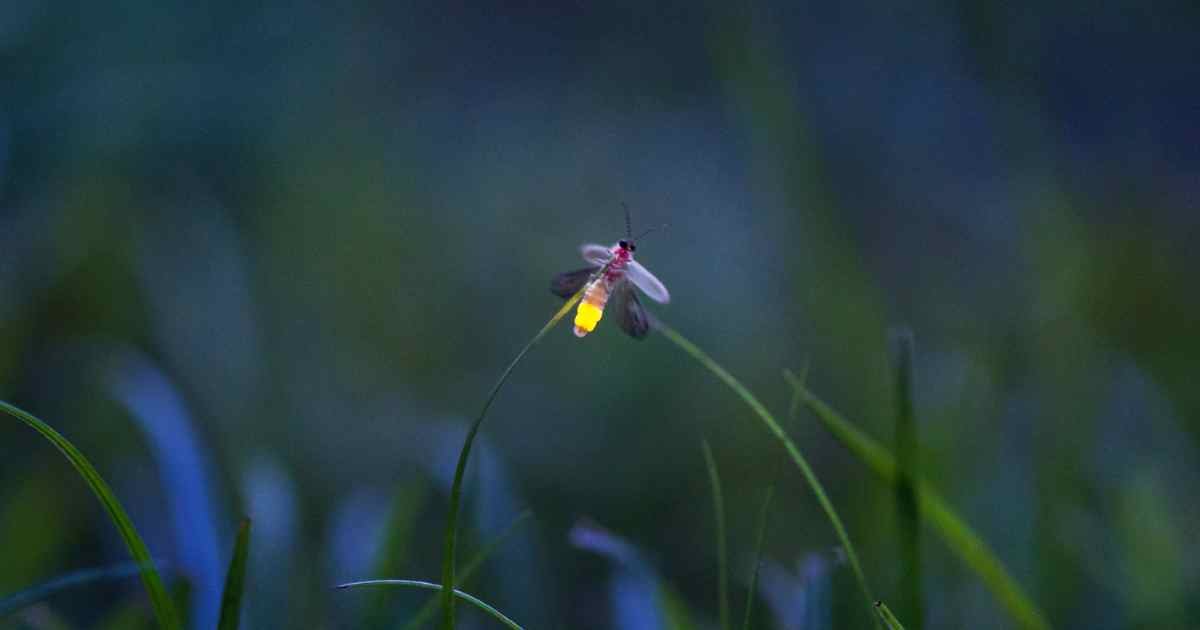
You’ve seen it — a warm summer night, a field flickering with small cold lights, appearing and vanishing in rhythmic pulses. Fireflies are one of the most visually striking things in nature. But the chemistry making it happen is even more remarkable than the light itself.
Most people assume the glow is simple — like a tiny lamp inside a bug. It’s not. Firefly bioluminescence is a precise, enzyme-driven chemical reaction that converts stored energy into light with almost zero heat loss. No human technology comes close to matching that efficiency.
This article covers exactly how the reaction works at a molecular level, why the light flashes in patterns, what the research says about its real-world applications, and which common explanations get the science wrong.
The Core Chemistry: What’s Actually Happening Inside a Firefly
The glow comes down to one reaction involving four key components.
Inside specialized cells called photocytes — located in the firefly’s abdomen — a molecule called luciferin reacts with oxygen in the presence of an enzyme called luciferase. The reaction also requires ATP (adenosine triphosphate, the energy currency of every living cell) and a magnesium ion to complete the chain.
When these four components combine, the luciferin molecule gets oxidized and enters a high-energy excited state. As it returns to its ground state, it releases that energy not as heat but as a photon — a particle of visible light. The technical term for the product is oxyluciferin, and the light it emits sits in the yellow-green range, roughly 510–670 nanometers depending on the species.
What makes this extraordinary is the efficiency. Standard incandescent light bulbs convert only about 10% of energy into visible light — the rest becomes heat. A firefly’s bioluminescent reaction converts close to 96% of the energy into light, with almost no thermal byproduct. Engineers have been studying this mechanism for decades, and no artificial system has replicated it at the same efficiency yet.
How Fireflies Control the Flash — The On/Off Mechanism
Understanding how fireflies glow is one thing. Understanding how they switch it on and off in controlled pulses is another, and this part of the science took researchers much longer to crack.
For years, scientists assumed fireflies controlled their glow by regulating oxygen delivery through their tracheal system — essentially opening and closing an air valve to start and stop the reaction. A 2001 study from the University of California challenged this model.
The current leading explanation involves nitric oxide (NO). Firefly photocytes contain high concentrations of mitochondria — the organelles that produce ATP. When a firefly wants to flash, the nervous system triggers the release of nitric oxide in the photocyte. Nitric oxide temporarily blocks mitochondrial respiration, which frees up oxygen that was being used for energy production. That sudden surge of available oxygen hits the luciferin-luciferase system and triggers a flash. When the nitric oxide disperses — which happens in milliseconds — the mitochondria resume normal function, oxygen gets consumed again, and the light goes off.
The entire on-off cycle can happen in as little as 0.3 seconds. Some species flash up to 3 times per second during peak mating activity.
Why Fireflies Flash: The Signaling System Behind the Light
The flash isn’t random. Every species has a species-specific flash pattern — a combination of pulse duration, interval timing, color, and flight arc that functions as a mating code.
In North America, Photinus pyralis — the most common backyard firefly — produces a single J-shaped flight arc with a half-second flash every 5–6 seconds. Males fly and flash; females sit in vegetation and respond with a precisely timed flash about 2 seconds after the male’s signal. That delay is the recognition handshake. A male that receives a correctly timed response flies toward it.
Researchers have catalogued over 2,000 firefly species globally, and each has a distinct flash signature. In a field containing multiple species simultaneously, this prevents cross-species mating — the species-specific pattern acts as a biological encryption key.
There’s a darker side to this signaling. Female Photuris fireflies — sometimes called “femme fatale fireflies” — have learned to mimic the flash responses of Photinus females. When a Photinus male approaches expecting a mate, the Photuris female captures and eats him, extracting his defensive chemicals (lucibufagins) in the process. I find this one of the clearest real-world examples of evolved deception in any animal communication system.
The synchronous fireflies of the Great Smoky Mountains (Photinus carolinus) take signaling even further. During their two-week mating season, thousands of males synchronize their flashes across entire hillsides — a phenomenon that draws thousands of visitors annually and is still not fully explained. The leading hypothesis involves males copying neighboring males’ flash timing to reduce signal overlap, which cascades into synchrony across the population.
Myths and Misconceptions About Firefly Bioluminescence
Myth 1: All glowing creatures use the same mechanism.
False. Bioluminescence evolved independently at least 50 times across different branches of life — in fish, jellyfish, fungi, bacteria, and dinoflagellates. Many use completely different chemical systems. Deep-sea anglerfish use a bacterial symbiosis; jellyfish use a protein called aequorin that reacts with calcium rather than oxygen. Firefly luciferin is specific to fireflies and a few closely related beetles.
Myth 2: The glow attracts prey.
In most firefly species, the glow is exclusively a mating signal. Larvae are the exception — firefly larvae also glow, and in that life stage the light is believed to serve as a warning signal (aposematism), advertising toxicity to predators. Adult fireflies that no longer glow after mating have essentially completed their biological purpose — most adult fireflies live only 3–4 weeks.
Myth 3: Fireflies are common everywhere.
Firefly populations have declined significantly across North America, Europe, and Asia over the past 30 years. The three primary causes are light pollution (which disrupts flash communication), habitat loss (they require moist, wooded areas with leaf litter for larval development), and pesticide use. A 2020 study published in the journal BioScience by Avalon Owens and colleagues identified these as the top threats and called for urgent conservation measures.
Myth 4: You can recreate a firefly glow with household chemicals.
Not practically. While luciferase and luciferin are available in laboratory-grade form (used extensively in medical research as reporter genes), the reaction requires precise pH conditions, ATP concentrations, and oxygen availability that don’t exist outside a controlled lab environment. Bioluminescence kits sold for educational use work — but they’re using purified reagents, not a DIY chemistry setup.
Real-World Applications of Firefly Chemistry
The luciferase-luciferin system has become one of the most valuable tools in modern biological research — and this is where the science moves well beyond nature trivia.
Because the reaction produces measurable light proportional to the amount of ATP present, luciferase acts as a perfect biological reporter. Scientists attach the luciferase gene to other genes they want to track. Wherever the target gene activates in a living cell or organism, a flash of light marks it. This technique has been used to study cancer cell behavior, track bacterial infections in real time, monitor gene therapy effectiveness, and map neural activity in living brains.
In 2017, MIT researchers used a modified luciferase system to create glowing plants — embedding the enzyme pathway into watercress and other species. The goal is eventually producing plants that provide ambient light without electricity. The current output is still far below practical lighting levels, but the proof of concept works.
Firefly luciferase also plays a key role in COVID-19 and other vaccine development, used in neutralization assays to measure how effectively antibodies block viral infection. The light-based readout is faster and more precise than many traditional methods.
Read More: What Happens to Your Brain When You Listen to Music?
FAQs
How do fireflies glow without getting hot?
The reaction converts chemical energy directly into photons through a process called chemiluminescence. Unlike combustion or incandescence, no significant heat is generated as a byproduct. Scientists call it “cold light.” The efficiency is approximately 96%, meaning almost all the energy input exits as visible light rather than thermal radiation.
What chemical makes fireflies glow?
The glow comes from a molecule called luciferin, which oxidizes in the presence of the enzyme luciferase, ATP, oxygen, and a magnesium ion. The reaction produces an excited intermediate that releases a photon of yellow-green light as it returns to its stable state. The exact emission color varies by species.
Do fireflies glow as larvae?
Yes. Firefly larvae — sometimes called glowworms — also bioluminesce, though they can’t flash on demand the way adults do. Their glow is believed to be a warning signal to predators, advertising that they contain toxic compounds. Some larvae glow even inside the egg before hatching.
Why don’t fireflies glow all the time?
Fireflies control their flash using nitric oxide, which temporarily diverts oxygen away from mitochondria and toward the luciferin reaction. When nitric oxide disperses, the oxygen supply returns to normal and the light goes off. The whole cycle happens in fractions of a second, giving the appearance of a controlled pulse.
Are fireflies endangered?
Not officially listed as endangered globally, but populations are in documented decline across multiple continents. A 2020 study in BioScience identified light pollution, habitat loss, and pesticide use as the three primary threats. Some localized species — including synchronous fireflies — face more serious regional pressure from tourism and habitat degradation.
Can the firefly glow mechanism be used in medicine?
Yes, extensively. Luciferase is one of the most widely used reporter genes in biomedical research. It helps scientists track gene expression, monitor infections, measure ATP levels in cells, and test drug effectiveness — all through real-time light output. It has been used in cancer research, vaccine testing, and neuroscience for over three decades.
What color do fireflies glow?
Most North American fireflies emit yellow-green light in the 560–570 nanometer range. Some species produce orange or even blue-green light depending on small structural differences in their luciferase enzyme. The specific emission wavelength is genetically encoded and species-specific.
Conclusion
Firefly bioluminescence is built on four molecules — luciferin, luciferase, ATP, and oxygen — executing a reaction with nearly perfect energy efficiency that no human technology has matched. The flash control system runs on nitric oxide. The flash patterns encode species-specific mating signals precise enough to prevent cross-species confusion across thousands of species simultaneously. And the same chemistry is now used daily in cancer labs, vaccine research, and gene therapy tracking.
The next time you see a field of fireflies, you’re watching a 96%-efficient cold-light reaction, a biological encryption system, and one of evolution’s most elegant solutions to communication — all at once.
If this sparked genuine curiosity, look up Avalon Owens’ firefly conservation research at Tufts University and the MIT glowing plants project. Both are publicly accessible and worth the read.
Your next great read is here—explore content that sparks new ideas and solutions.
