

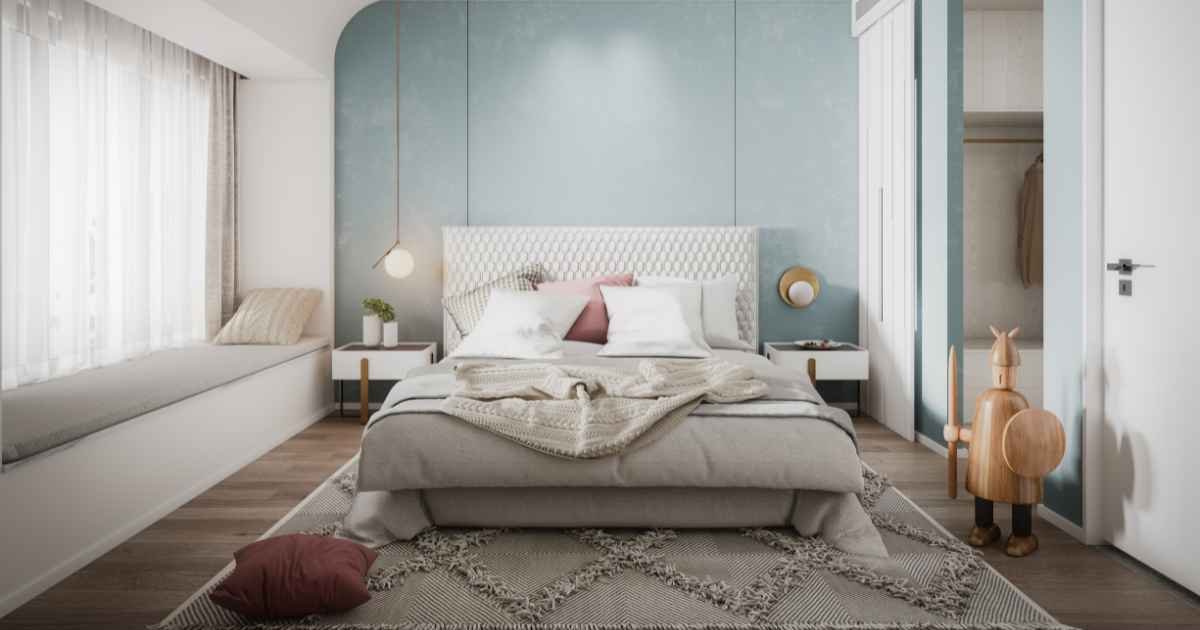
The average US master bedroom shrank from 309 square feet in 2018 to 279 square feet in 2024, according to National Association of Home Builders data. Add a second person and a queen bed, and most couples have less than 100 square feet of actual floor space to work with.
I have redesigned three small bedrooms with my partner over six years across two apartments and a starter home. Each redesign came in under $500 total, and each one made the room feel dramatically bigger, more organized, and more restful.
This guide covers the small bedroom ideas for couples on a budget that actually work in real US apartments. Layout tricks, storage solutions, color choices, and specific product picks under $150 each. No magazine-perfect fantasy setups. Just what fits, functions, and lets two people share a small room without frustration.
Why small bedrooms feel small (and how to fix it)
Room size is only half the problem. The other half is layout, lighting, and visual clutter.
A 10 by 11 room with a well-placed queen bed and clean sightlines feels bigger than a 12 by 13 room stuffed with mismatched furniture. Interior designers call this “perceived space,” and it responds to five specific interventions.
Vertical storage over horizontal. Every inch of floor space that holds furniture is one less inch to walk. Move storage up.
Continuous sightlines. The floor should be visible under most furniture. Solid furniture on the floor blocks the eye and shrinks the room visually.
One or two large elements instead of many small ones. Ten tiny frames create clutter. One large piece of art anchors the wall.
Cool, light color palette. Whites, soft grays, sage greens, and light blues reflect light and expand perceived space. Dark browns and heavy patterns shrink it.
Layered lighting instead of one overhead bulb. A single ceiling light creates harsh shadows that emphasize how small the room is. Multiple soft light sources make the room feel bigger and warmer.
The five combined interventions can transform a bedroom without touching a wall or spending big money.
The 8 best small bedroom ideas for couples on a budget
Ranked by return on investment (visual impact per dollar spent).
1. Wall-mounted nightstands (saves 3-5 sq ft each)
Traditional freestanding nightstands eat 4 to 6 square feet of floor space. Wall-mounted floating nightstands mount at bed height and free up all the floor under them.
Best budget picks: IKEA MOSSLANDA picture ledge ($10-$15 each) works as a minimal nightstand. Wayfair floating shelves ($25-$60 each) offer larger surface area.
Real impact: Removing two bulky nightstands and replacing with floating shelves in my last apartment made the room feel roughly 20% larger without changing anything else.
2. Under-bed storage boxes (recover 15-25 sq ft)
The space under a queen bed is 33 square feet of dead area in most bedrooms. Rolling storage bins under the bed reclaim it entirely.
Best budget picks: IKEA SKUBB storage cases ($10-$20 for a 6-pack), plastic under-bed bins with wheels from Target ($15-$25 each), or vacuum storage bags for seasonal clothes ($20 for a 6-pack).
What to store: Off-season clothes, extra bedding, shoes, gift-wrapping supplies. Anything you touch less than monthly belongs under the bed, not in your closet.
3. Wall-to-ceiling shelves above the bed or door
Every couple has vertical wall space they are wasting. The 24 to 36 inches between the top of a doorway and the ceiling is prime storage that most people ignore.
Best budget picks: IKEA BILLY bookcase extended to ceiling ($60-$100), floating shelves installed above the door ($30-$50), or a corner shelving unit ($40-$80).
Real impact: Adding a ceiling-height shelf above the doorway in my current bedroom added the equivalent of a small dresser worth of storage without touching floor space.
4. Multi-function bed frames with drawers or lift storage
Beds with built-in storage add 15 to 30 cubic feet of internal storage without adding a single square foot of floor space. Not the cheapest single item, but the best long-term investment.
Best budget picks: IKEA MALM bed with 4 drawers ($299 in queen), IKEA HEMNES daybed with drawers ($399), or Walmart storage beds ($200-$400).
Warning: Cheap storage beds under $200 often have drawer mechanisms that fail within 2 years. Spend $300-plus for longevity.
5. Mirrors to double perceived space
A large mirror opposite a window or door instantly makes a room feel double its actual size. Not new advice, but consistently ignored because people place mirrors purely for function (grooming) rather than visual expansion.
Best budget picks: IKEA MITTLEISBERG or STAVE floor mirrors ($40-$100), thrift store or Facebook Marketplace mirrors ($15-$50), or a full-length door mirror ($20-$40).
Real impact: A 5-foot mirror leaned against the wall opposite my bedroom window makes the room feel roughly 30% larger. Total cost: $38.
6. Sliding door replacement for swinging closet doors
Traditional closet doors swing open into the room and block 6 to 10 square feet of usable floor space. Sliding or folding doors reclaim that space entirely.
Best budget picks: IKEA PAX system with sliding doors ($200-$500 depending on width), sliding door track kits from Home Depot ($40-$80), or curtain-rod-and-fabric setups ($30-$50).
Real impact: Replacing swinging closet doors with sliding barn doors in a rental apartment reclaimed the equivalent of a bedside table’s worth of floor space.
7. Light-blocking blackout curtains that mount above the window
Curtain rods mounted 6 to 12 inches above the window (and extending 4 to 6 inches beyond each side) make the window look taller and the ceiling feel higher. Blackout function helps couples with different sleep schedules.
Best budget picks: NICETOWN blackout curtains ($25-$40 per panel on Amazon), IKEA MAJGULL blackout curtains ($40-$60 per pair), or extra-long IKEA MERETE curtains ($30-$40 per pair).
8. One large statement piece instead of gallery walls
Small bedrooms drown under gallery walls with 8 to 12 small frames. One large piece of art (30 inches by 40 inches or larger) creates a focal point without clutter.
Best budget picks: Printable art from Etsy ($5-$15) framed in an IKEA RIBBA frame ($20-$50), oversized canvas prints from Society6 or Redbubble ($60-$120), or thrift store finds ($10-$40).
Small bedroom layout tricks that make a huge difference
Center the bed on the longest wall. Anchoring the bed against the longest interior wall opens up the two shorter walls for storage and movement.
Leave 24 to 30 inches of walking space on both sides of the bed. Couples need matching access to both sides. Sacrifice everything else to preserve these two paths.
Push the bed into a corner if you are truly tight. Some couples sleep fine with one person needing to climb over. If floor space is that tight, sacrifice one-sided access.
Use furniture with legs. Beds, dressers, and nightstands with visible legs let the eye see the floor underneath, which enlarges perceived space. Solid platform beds shrink the room visually.
Skip the reading chair. Small bedrooms rarely have room for a chair. Read in bed or in the living room. Every square foot occupied by a chair is one you cannot walk through.
Storage comparison for small bedrooms
| Storage Idea | Cost | Space Recovered | Effort |
|---|---|---|---|
| Under-bed bins | $30-$50 | 15-25 sq ft | 1 hour |
| Wall-mounted shelves | $30-$80 | 5-10 sq ft floor | 2-3 hours |
| Ceiling-height shelves | $60-$120 | 10-20 sq ft floor | 3-4 hours |
| Storage bed frame | $300-$400 | 15-30 cu ft | 2-3 hours |
| Sliding closet doors | $40-$500 | 6-10 sq ft | 3-6 hours |
| Over-door storage | $20-$50 | 3-5 sq ft floor | 15 minutes |
Under-bed storage delivers the best ROI in every small bedroom I have worked on. Start there before anything else.
Common mistakes couples make with small bedrooms
Two matching nightstands “for symmetry.” Symmetry is nice but not required. If space is tight, one nightstand plus one wall-mounted shelf works just as well and saves floor space.
Buying furniture too tall for the room. A tall dresser in a small room dominates the space visually. Choose lower, wider furniture instead of tall, narrow.
Dark accent walls in small rooms. Dark colors can work in bedrooms, but small ones rarely benefit. Light walls with dark accent pieces (art, bedding) achieve the mood without shrinking the room.
Keeping every piece of furniture from single life. Newly cohabiting couples often try to fit two full sets of bedroom furniture into one small room. Sell half. Merged households need pared-down furniture, not doubled.
Ignoring the vertical space above the door. Almost every small bedroom has 24 to 36 inches of unused wall space above the doorway. That is real storage waiting to be built.
Skipping window treatments. Bare windows in a small room look unfinished and cold. Even $30 curtains dramatically warm the space.
Weekend redesign plan under $500
Total time: one weekend. Total budget: under $500 (often under $300).
Saturday morning: Declutter. Remove everything you have not touched in 6 months. Sell or donate. The room feels bigger before you spend a dollar.
Saturday afternoon: Rearrange existing furniture. Try three different bed placements. Move the dresser. Try the mirror against different walls. Take photos of each layout to compare.
Saturday evening: Order online. Under-bed storage bins ($40), wall-mounted floating shelves ($60), a large mirror if you do not already have one ($50), a set of blackout curtains ($60), and one large piece of wall art ($40). Total roughly $250.
Sunday morning: Install the floating shelves and hang the art. Set up the under-bed storage.
Sunday afternoon: Hang curtains 6 to 12 inches above the window. Lean the mirror against the wall opposite. Adjust bedding for a fresh look.
By Sunday evening, the room feels transformed for under $300 in most cases.
Frequently asked questions
What is the best layout for a small bedroom shared by a couple?
Center the bed on the longest wall with 24 to 30 inches of walking space on both sides. Place the dresser on a shorter wall, use wall-mounted or floating nightstands to save floor space, and reserve one wall for closet or vertical storage. This layout works for the majority of US small bedrooms under 120 square feet.
How can I make a small bedroom feel bigger on a budget?
Five changes deliver the most impact for the least money: paint walls a light color, add a large mirror opposite a window, hang curtains high above the window frame, declutter aggressively, and switch to furniture with legs instead of solid bases. Total cost typically under $150.
What color makes a small bedroom look bigger?
Cool, light colors expand perceived space. Soft whites, pale grays, sage greens, and light blues all work. Avoid dark browns, deep reds, and heavy patterns. Ceilings painted a shade lighter than the walls make the room feel taller.
How do you fit two people’s stuff in a small bedroom?
Vertical storage is the answer. Wall-mounted shelves, ceiling-height bookcases, over-door hooks, and under-bed bins add storage without floor space. Combined with aggressive decluttering (removing anything used less than monthly), most couples can fit their essentials without feeling crowded.
What is the best bed size for a small bedroom shared by a couple?
Queen beds are the sweet spot for most small bedrooms. Full beds are usually too small for two adults long-term. King beds fit only in bedrooms over 130 square feet with proper walking space. Storage-integrated queen beds are the single highest-value furniture purchase for small-bedroom couples.
Should I skip a headboard to save space?
No, but choose a slim wall-mounted headboard instead of a floor-mounted one. A wall-mounted or upholstered thin headboard adds visual anchor without taking floor space. Skipping a headboard entirely often makes the room feel unfinished.
Can two people share a dresser in a small bedroom?
Yes, and this is often the best space-saving move for couples. One taller dresser (5 to 6 drawers) shared between two people saves 8 to 12 square feet versus two separate dressers. Assign drawers to each person.
What is the biggest mistake in small bedroom design?
Trying to fit too much furniture. Every extra piece shrinks the room visually. A minimalist approach with fewer, well-chosen pieces almost always beats a “fully furnished” approach in small bedrooms. Sell what does not fit rather than cramming it in.
How much should I spend redesigning a small bedroom on a budget?
$200 to $500 handles most small bedroom transformations. Under $200 works if you already have a bed and just need storage. $500 opens up furniture upgrades like a storage bed or new dresser. Above $1,000 typically means you are buying more than you need.
Redesign your small bedroom this weekend
Small bedrooms for couples are not about compromise. They are about design choices that respect the space rather than fight it.
Pick 3 to 5 ideas from this guide matching your specific room. Declutter first, rearrange next, and only buy new items to fill genuine gaps. The best small bedroom redesigns keep 60% to 70% of what you already own.
Start today: Walk into your bedroom right now with a trash bag. Remove everything on flat surfaces you have not used in the last 30 days. That single 15-minute action makes the room feel measurably bigger before you spend a dollar on new furniture.
Make your routine smarter—tap into our collection of clever hacks and everyday breakthroughs.
