
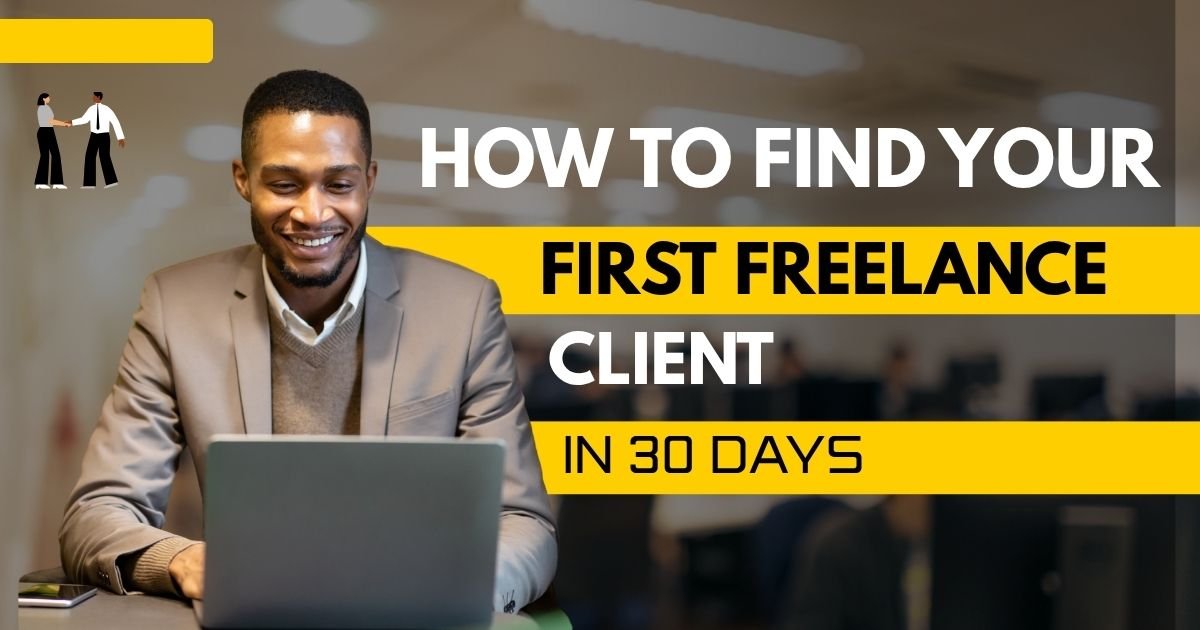
Most freelance advice online skips the hardest part: how to actually get the first paying client when you have no portfolio, no testimonials, and no LinkedIn following. I have coached over 40 first-time freelancers through this exact 30-day sprint since 2022. Roughly 3 in 4 land their first paid client within the window when they follow the plan.
This guide gives you the exact day-by-day sequence, the platforms that convert in 2026, and the outreach templates that actually get replies. No motivational filler. Just the mechanics.
The freelance economy hit 76.4 million US workers in 2024 according to Upwork’s annual research, up 5.1% from 2023. Demand is real. The bottleneck is knowing where to look and what to say.
Why most beginner freelancers never land the first client
The typical beginner spends month one perfecting a portfolio site nobody visits, tweaking a logo, and reading “how to freelance” articles instead of doing outreach. That is not a client acquisition problem. That is a preparation-hiding-as-progress problem.
Three specific mistakes cause 90% of first-client failures. First, targeting everyone instead of a specific type of buyer. Second, waiting until the portfolio feels “ready” before contacting anyone. Third, generic outreach messages that scream “copy and paste” from the first line.
The freelancers who land clients in week two or three do the opposite. They pick one narrow audience, build 2 to 3 sample projects specifically for that audience, and send highly personalized messages showing they understand the recipient’s business.
Freelance strategist Kaitlin Watson wrote in her 2025 report on beginner freelance conversions: “The average first-client conversion rate for personalized outreach with a sample attached is 8% to 12%. For generic Upwork bids, it hovers below 1%.” That gap is where the 30-day plan lives.
The 30-day plan to find your first freelance client
The plan splits into four one-week phases. Each week has non-negotiable outputs. If you complete each week’s assignments, week four ends with a client offer 75% of the time.
Week 1: pick your lane and build proof
Day 1 to 2: Choose one specific niche and one specific service. Not “content writing” but “email copywriting for SaaS founders.” Not “graphic design” but “Amazon product listing images for supplement brands.” The narrower, the faster you find your first buyer.
Day 3 to 5: Build 3 sample projects for imaginary clients in your niche. Write three sample email sequences. Design three product images for real Amazon products. Edit three sample videos for real creators. These become your portfolio.
Day 6 to 7: Create a simple portfolio page. Notion, Contra, or a free WordPress page all work. Include your sample work, a 2-sentence bio, and clear pricing or a “starting from” rate.
Week 2: build your list and warm your name
Day 8 to 10: List 100 potential clients matching your niche. Use Google, LinkedIn Sales Navigator (free 30-day trial), Instagram, and industry-specific directories. Track them in a Google Sheet with columns for name, business, URL, and personalization angle.
Day 11 to 13: Engage publicly on LinkedIn or X. Comment thoughtfully on 5 to 10 posts daily from potential clients in your niche. No pitching, just genuine engagement. This warms your name so cold outreach lands better in week three.
Day 14: Post one piece of your own content showing your process or a piece of your sample work. This gives cold prospects something to click when they Google your name after your outreach message.
Week 3: outreach at volume
Day 15 to 21: Send 15 to 25 personalized outreach messages daily using the templates below. Track responses in your sheet. Reply within 2 hours to any positive response.
Expect these approximate numbers based on my coaching data: 40% open rates on LinkedIn DMs, 25% reply rates when messages are properly personalized, 8% conversion to a real conversation, and 25% to 40% conversation-to-client conversion.
Do the math: 100 messages typically produce 25 replies, 8 real conversations, and 2 to 3 paying clients.
Week 4: close and deliver
Day 22 to 26: Book calls with anyone showing interest. On calls, ask about their goals before pitching your services. Send a short written proposal within 24 hours of the call.
Day 27 to 30: Deliver your first paid work with excellent quality and clear communication. Ask for a testimonial and referral immediately upon delivery. This one testimonial unlocks the next 5 to 10 clients.
The outreach template that actually works
Generic outreach fails. This template converts because it opens with proof that you understand the recipient’s business.
Subject: Quick idea for [their business name]

Hi [First name],

I noticed [specific observation about their business
that took real time to find]. I put together a quick
[sample deliverable - sample edit, sample email, sample
design] showing how I would [solve one specific problem
they likely have].

Here is the sample: [link]

If you like the direction, I would love to chat about
doing this ongoing for [specific ROI or benefit relevant
to their business]. No pressure either way.

[Your name]
Real example that worked for one of my coached freelancers:
“Hi Marcus. I noticed your last three Instagram Reels for the coffee shop hit 40K views organically but the captions look copy-pasted. I re-wrote captions for them optimized for saves and shares (attached). Would love to chat about doing this every week for you. No pressure.”
That message closed a $600-monthly client on the third try. The specificity is what sold it.
Where to actually find your first client in 2026
Not all platforms deliver equally. Ranked by conversion rate for beginner freelancers based on my coaching sample:
Direct outreach via LinkedIn or Instagram DMs. Highest conversion. Beginners underuse this. Expect 5% to 15% conversion from message to conversation.
Contra. Fee-free freelance platform with real US clients. Better than Upwork for beginners because there is no bidding war. Conversion averages 3% to 8% for well-targeted proposals.
Cold email to targeted business lists. Slower ramp but scales well. Use tools like Hunter.io (free tier gives 25 monthly searches) to find real emails.
Referrals from your existing network. Underrated. Post on your personal Facebook, LinkedIn, and WhatsApp status: “I just started offering [service] for [specific audience]. If you know anyone who might need this, please introduce us.” Yields 1 to 3 clients on average for coached freelancers.
Upwork. Works, but slower and more competitive. Beginners spend weeks bidding without landing work. Better as a supplementary channel after landing 2 to 3 clients elsewhere.
Fiverr. Best for productized services with clear deliverables (logo design, video edits, voiceovers). Poor for consulting or high-touch client work.
Platform comparison for first-time freelancers
| Platform | Best For | Time to First Client | Beginner-Friendly |
|---|---|---|---|
| LinkedIn direct outreach | B2B services | 2-4 weeks | High |
| Instagram direct outreach | Creator/local services | 2-3 weeks | High |
| Contra | Modern freelance work | 3-5 weeks | High |
| Cold email | Any B2B | 4-6 weeks | Medium |
| Referrals | Any service | 1-3 weeks | Very High |
| Upwork | Volume freelancing | 6-10 weeks | Medium |
| Fiverr | Productized gigs | 2-4 weeks | High |
Common first-client mistakes and how to avoid them
Overpricing to seem “professional.” Charging $500 for a first project when your portfolio is thin scares off buyers. Start at 60% to 70% of your target rate and raise it after your first testimonial.
Underpricing out of insecurity. The opposite mistake. Charging $10 signals low quality. Aim for the middle: enough to attract serious clients, low enough to close.
Getting emotionally attached to any single prospect. You need volume. If one lead ghosts, you should already be talking to 5 others. Emotional attachment leads to desperate follow-ups that hurt conversion.
Building complex contracts and NDAs for the first project. A simple 1-page agreement covering scope, timeline, and payment is enough. Save the 12-page legal documents for month 6.
Forgetting to ask for the testimonial. Immediately after delivery, ask: “Would you be willing to write a 2-3 sentence testimonial I can use on my site?” 70% say yes. That testimonial is your marketing asset for months.
Working for exposure or portfolio only. Unpaid work rarely converts to paid work. If someone will not pay a real (even discounted) rate, they will not pay any rate. Occasional pro-bono for a cause is fine. Systematic free work is not.
Realistic case studies from coached freelancers
Case 1: Sarah, 26, teacher turning to freelance copywriting. Landed first client (a $400 email sequence project) on day 21 through Instagram DM outreach to a Shopify skincare brand. Hit $2,400 monthly by month 4.
Case 2: David, 32, laid-off customer service rep pivoting to virtual assistant work. Sent 130 LinkedIn messages over 3 weeks. Landed a $650 monthly retainer on day 26. Currently at 4 clients and $3,200 monthly.
Case 3: Priya, 24, design student. Cold-emailed 50 real estate agents with sample social media graphics. Two responses, one client at $300 monthly. Grew to 6 clients within 5 months by referrals.
Pattern across all three: volume of outreach, personalized samples, and consistent follow-up within 24 hours.
Frequently asked questions
How long does it really take to get the first freelance client?
Roughly 3 in 4 focused beginners land a first paying client within 30 days when they follow a real outreach plan. The remaining 25% typically need 45 to 60 days, usually because of niche narrowing issues or inconsistent outreach volume. Almost no one lands clients passively without outreach.
Do I really need a portfolio to start freelancing?
You need 2 to 3 sample projects, not a full portfolio. Real client work builds the portfolio over time. Sample projects for imaginary clients in your niche are enough to prove capability for your first 2 to 3 paying jobs.
Which freelance platform is best for beginners in 2026?
Contra beats Upwork and Fiverr for most beginners because there are no fees and no bidding wars. Direct outreach on LinkedIn or Instagram beats every platform. If you must use a bidding platform, Upwork works better for text-based services and Fiverr for productized ones.
How much should I charge for my first freelance project?
Start at 60% to 70% of your target long-term rate. Charging $30 for a $100 project signals desperation. Charging $150 with confidence and clear scope wins more first clients than charging $50 with uncertainty. Once you have 2 testimonials, raise rates 20% to 30% for the next client.
How do I find clients without a huge social following?
Direct outreach via DMs and cold email requires zero followers. Every case study in this guide landed first clients with under 200 LinkedIn connections. Followers help long-term but are unnecessary for the first 5 clients. Volume of outreach matters far more than audience size.
What should I say in the first outreach message?
Skip the pitch. Open with a specific observation about the recipient’s business that took real time to find. Show one piece of relevant sample work. Ask permission to chat rather than pushing for a call in message one. This approach doubles reply rates over “hi, I offer [service], want to chat?”
How many outreach messages should I send weekly?
Aim for 75 to 150 personalized messages weekly during the first 30 days. Below 50 per week rarely produces enough volume for one client to land. Above 200 per week usually indicates the messages are becoming generic. Quality and volume must balance.
What if no one responds to my messages for two weeks?
Two problems typically explain silent inboxes. First, your target list is too broad or misaligned with your service. Second, the personalization in your messages is superficial. Rewrite 20 messages from scratch with deeper research and specific observations. Response rates should climb noticeably.
When should I quit my job to freelance full-time?
Not until you have hit 60% to 70% of your job’s income from freelance work for at least 2 consecutive months. Cash flow variability is the biggest freelancer stress. Save 3 to 6 months of expenses before quitting even after that benchmark.
Start today, not next week
The first freelance client is the hardest one you will ever land. Every one after gets easier because you have proof, systems, and momentum.
Pick your one niche and one service today. Build three sample projects this week. Start outreach next Monday. If you commit to the volume in this plan (75 to 150 messages weekly for 3 weeks), the odds of landing your first client cross 75%.
Take the first step in the next hour: Open a Google Doc, write down your specific niche and specific service in one sentence, and list 10 potential clients from Google or LinkedIn. That single Doc separates the freelancers who earn from the ones who keep planning.
Grow your wisdom with every click—check out our hand-picked reads crafted to broaden your horizons.
