









Assimilation: Meaning, Process and Social Impact
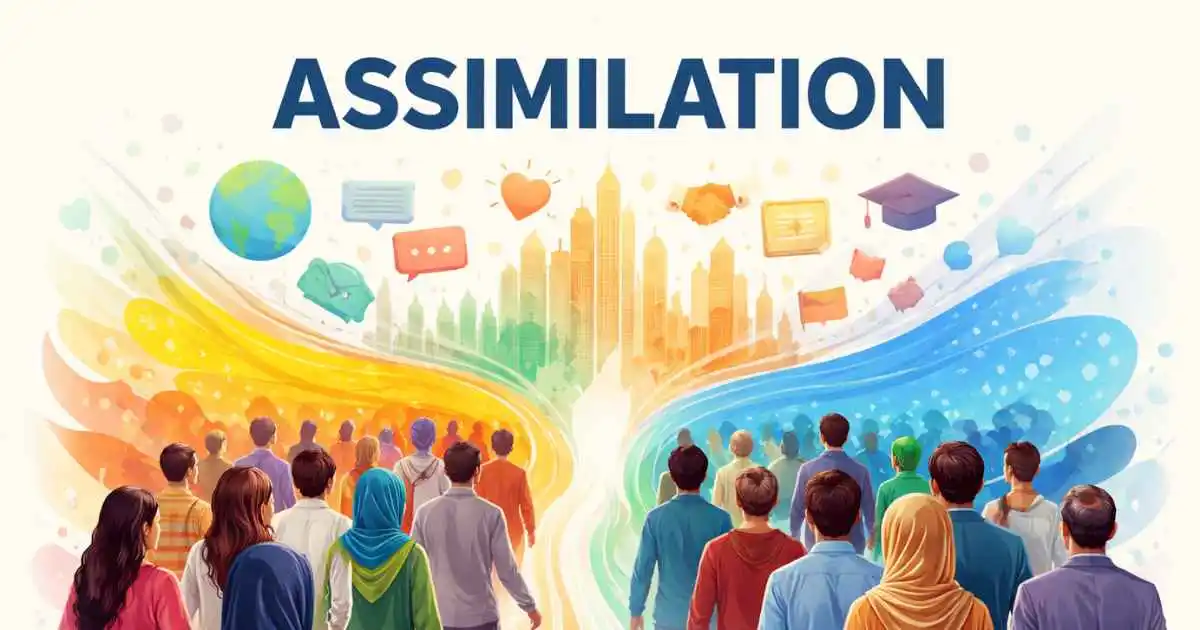
Assimilation is a long-term social process through which individuals or groups gradually align themselves with the dominant norms, institutions, and value systems of a society. It involves far more than surface-level imitation of customs. Instead, it represents a deeper integration into economic systems, educational structures, political institutions, and social networks.
In modern multicultural societies, assimilation has become a central issue due to migration, globalization, and digital communication. As different communities interact, adaptation becomes necessary for participation and opportunity. Assimilation describes how this adaptation unfolds and how individuals position themselves within a broader social framework.
Importantly, assimilation is not automatic or uniform. It is influenced by social acceptance, economic opportunity, public policy, and generational change. Understanding assimilation requires examining its structural and psychological dimensions rather than reducing it to simple cultural adjustment.
Take control of your goals—discover knowledge that drives results.
Meaning and Scope of Assimilation
Assimilation refers to incorporation into an existing social structure. This incorporation operates across behavioral, institutional, and identity-based levels. Behavioral changes may include language use, communication style, dress norms, and public conduct aligned with mainstream expectations.
Beyond visible behavior, assimilation involves institutional participation. Access to schools, labor markets, healthcare systems, and political structures reflects deeper integration. Without structural inclusion, cultural conformity alone cannot ensure equality or belonging.
The scope of assimilation therefore includes cultural alignment, economic mobility, social participation, and psychological belonging. It is a multidimensional process that shapes how individuals navigate opportunity and identity within complex societies.
Historical Development of Assimilation Theory
The idea of assimilation gained prominence during large migration movements in the nineteenth and twentieth centuries. Early theorists believed immigrants would gradually abandon distinct traditions and merge into a unified national identity. This belief was often summarized by the “melting pot” metaphor.
Over time, historical evidence challenged this assumption. Many groups adopted dominant cultural practices yet continued to face discrimination and economic inequality. Cultural similarity did not automatically lead to equal treatment or opportunity.
As sociological research advanced, scholars recognized that assimilation is shaped by structural factors such as public policy, economic systems, and social attitudes. Modern theory therefore treats assimilation as context-dependent and influenced by power dynamics rather than as a simple linear process.
Cultural and Linguistic Transformation
Cultural assimilation often begins with observable changes in daily life. Individuals may adjust lifestyle habits, public etiquette, and social expectations through interaction with mainstream institutions. These adjustments develop gradually through education, employment, and media exposure.
Language plays a central role in cultural transformation. Fluency in the dominant language increases access to education and employment opportunities. Generational patterns frequently show stronger attachment to heritage language among first-generation migrants and greater dominance of mainstream language in later generations.
While language acquisition enhances participation, it can also weaken transmission of cultural memory tied to ancestral languages. Cultural and linguistic transformation therefore reflects both expanded opportunity and potential heritage loss within evolving communities.
Economic and Institutional Integration
Economic assimilation refers to participation in labor markets and progress toward income equality. Stable employment, entrepreneurship, and professional advancement signal deeper integration into the economic system.
Institutional integration extends beyond income. It involves representation in governance, higher education, corporate leadership, and civic organizations. When minority groups gain influence in these areas, inclusion becomes more substantial and sustainable.
However, structural barriers may limit progress. Discrimination in hiring, housing, or political access can persist even when individuals adopt dominant norms. Meaningful institutional integration therefore depends on inclusive policies and equal access rather than cultural conformity alone.
Social Networks and Identity Formation
Social relationships strongly influence assimilation patterns. Cross-cultural friendships, integrated neighborhoods, and intermarriage reduce social boundaries and create shared experiences. As these networks expand, mutual understanding increases.
Identity formation evolves alongside social interaction. Individuals may retain attachment to heritage traditions while developing emotional belonging within the dominant society. Rather than replacing one identity with another, many cultivate hybrid identities that combine multiple influences.
This layered identity challenges the assumption that assimilation requires cultural abandonment. Modern belonging is often multidimensional and shaped by both origin and host environments.
Generational Patterns of Assimilation
Assimilation typically unfolds across generations. In early stages, adaptation is largely practical, allowing individuals to navigate institutions while maintaining strong ties to their cultural roots.
As participation becomes routine, schools, workplaces, and peer networks influence values and expectations. Cultural blending becomes normalized rather than strategic. Exposure to dominant narratives shapes perspectives on belonging and opportunity.
In later stages, generational consolidation occurs. Children raised within mainstream institutions often internalize dominant cultural frameworks more fully than their parents. Heritage traditions may persist privately, but identification may shift toward national identity.
Theoretical Perspectives and Contemporary Approaches
Classical assimilation theory proposed that cultural differences would gradually disappear through sustained interaction. This model assumed a single pathway toward uniformity and eventual similarity.
Later research introduced more complex perspectives, recognizing multiple assimilation trajectories. Some communities achieve upward mobility and institutional inclusion, while others face marginalization despite adaptation. Social context plays a decisive role in shaping these outcomes.
Contemporary approaches emphasize agency and negotiation. Individuals actively determine how much adaptation to pursue and which traditions to preserve. Assimilation is therefore dynamic, context-driven, and influenced by both structural opportunity and personal choice.
Benefits and Opportunities
When voluntary and supported by inclusive institutions, assimilation can generate meaningful advantages. Economic mobility improves as language proficiency and cultural familiarity enhance employability and professional advancement.
Shared communication norms promote cooperation and civic participation. Individuals who feel included are more likely to engage in democratic processes and contribute to community initiatives.
Potential benefits include expanded employment prospects, higher educational attainment, broader social networks, increased civic engagement, and stronger social cohesion. These advantages depend on fairness and institutional openness rather than simple conformity.
Risks and Ethical Considerations
Assimilation also presents important challenges. Cultural erosion may occur when heritage languages and traditions decline across generations. Loss of intergenerational knowledge weakens cultural continuity and diversity.
Identity conflict can affect younger generations navigating expectations from both family and society. Psychological stress may persist when adaptation does not eliminate structural discrimination.
Historically, forced assimilation policies caused significant harm by suppressing minority cultural expression. Ethical assimilation requires voluntary participation, equal institutional access, protection of cultural rights, and safeguards against discrimination.
Assimilation in the Contemporary Global Context
Globalization has reshaped assimilation patterns. Digital communication enables migrants to maintain strong connections with origin cultures while participating in host societies. Cultural exchange now moves in multiple directions.
Hybrid identities have become increasingly common, blending national, ethnic, and global influences. Assimilation today often involves integration without complete replacement of heritage traditions.
Governments continue to refine policies balancing unity and diversity. Modern assimilation is less about uniformity and more about negotiating belonging within interconnected social systems shaped by mobility and communication.
Conclusion
Assimilation is a multidimensional process influencing behavior, institutions, identity, and generational continuity. It is shaped by structural conditions, policy frameworks, and individual agency.
While assimilation can enhance opportunity and strengthen social cohesion, it also raises concerns about cultural preservation and equality. Its outcomes depend on fairness, inclusion, and mutual respect.
In contemporary societies, assimilation represents negotiation rather than simple conformity. Recognizing its complexity allows for more balanced and inclusive approaches to integration.
Upgrade your thinking with inspiring perspectives—dive in today.